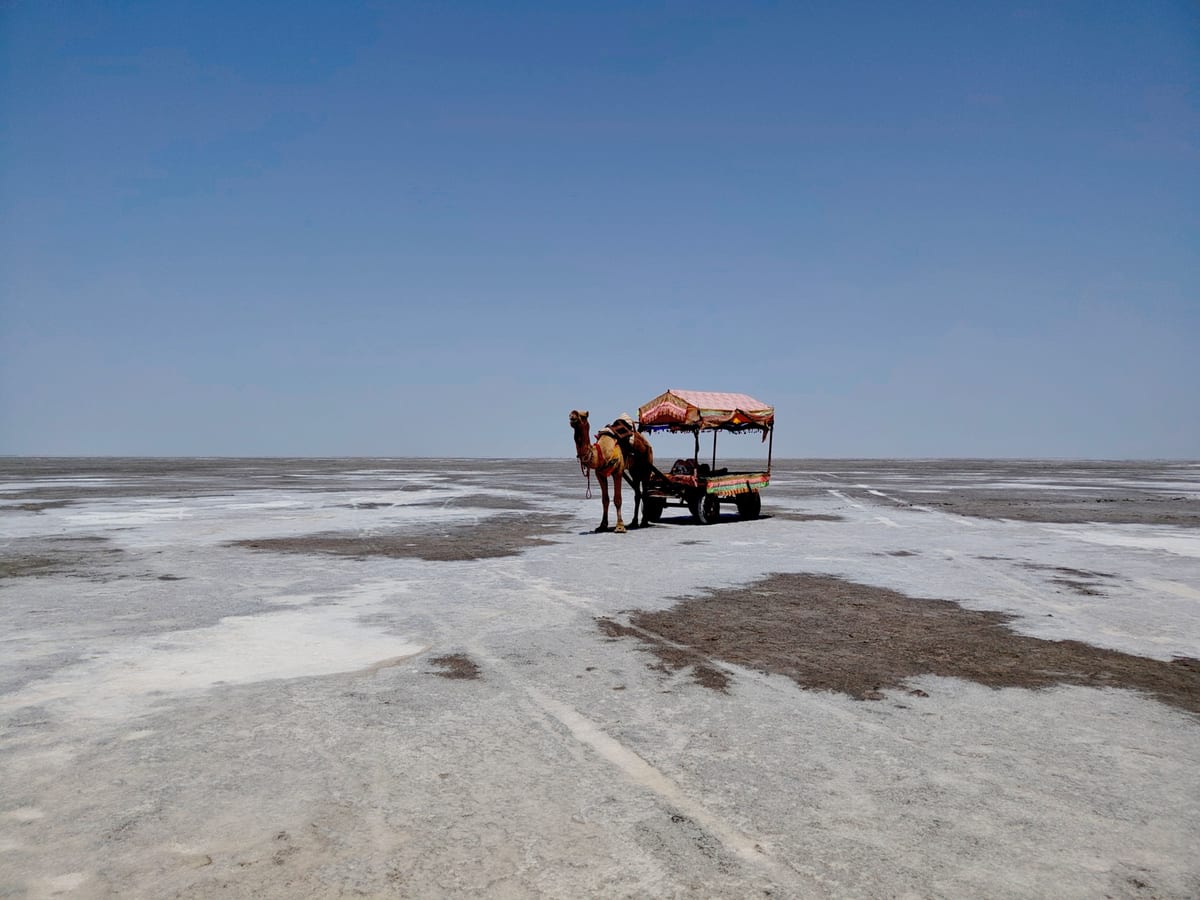
There is a moment, just after sunset, when the Rann of Kutch becomes something that resists ordinary description. The salt crust beneath your feet glows faintly, the horizon disappears, and you are left standing in what feels like the edge of the world, or perhaps its very beginning. This is Gujarat's great white desert, and it has shaped the experience of travellers, traders, and wanderers for thousands of years.
A Landscape Born of Ancient Waters
The Rann of Kutch, from the Sanskrit word Rann, meaning desert, is one of the world's largest salt marshes, spanning roughly 30,000 square kilometres across the Kutch district of Gujarat. Divided into the Great Rann in the north and the Little Rann to the southeast, this vast expanse was once an arm of the Arabian Sea. Geological shifts and sediment deposits transformed it over millennia into the glittering tidal flatland visible today. During the monsoon, shallow waters return to reclaim parts of the Rann; by winter, it dries into an endless white plain, cracked and crystalline, catching moonlight like a mirror laid flat across the earth.
The Rann is remarkable for its scale and its age. The nearby Harappan settlement of Dholavira, a UNESCO World Heritage Site, ranks among the five largest cities of the Indus Valley Civilisation, dating back more than 4,500 years. The people who lived here traded, built sophisticated water systems, and left behind a script still being decoded. The Rann was not their backdrop, it was their world. To stand here is to stand in civilisational time, not tourist time.
The Living Culture of Kutch
India's heritage is never merely archaeological. It is living and breathing, often found in the hands of an artisan who learned her craft from her grandmother, who learned it from hers. Kutch exemplifies this continuity. The region has over a dozen distinct craft traditions: Ajrakh block printing, Rogan art (a rare form of thread painting using castor oil-based paint), intricate mirror-work embroidery, Bandhani tie-dye, leather mosaic work, and copper bell-casting, among others. These are not revival crafts. They are unbroken lineages.
The communities of Kutch, the Rabari herders, the Mutwa embroiderers, the Jat weavers, have carried these traditions across centuries of migration, drought, earthquake, and political change. Their art is an act of civilisational memory. When a Rabari woman stitches geometric patterns into her bodice, she is not making fashion; she is narrating her community's cosmology. India's heritage is not preserved in glass cases. It is worn, used, gifted, and passed on.
The Rann Utsav: A Festival of White Horizons
Every year, from November through February, the Rann Utsav transforms the edge of the Great Rann into a cultural celebration. Organised under the Gujarat Tourism initiative and supported by the Incredible India platform of the Ministry of Tourism, the festival brings together folk musicians, artisans, dancers, and food producers from across Kutch and beyond. Tent cities rise from the white ground. Camel safaris thread across moonlit salt flats. Traditional Garba circles form under open skies.
The Rann Utsav is one of India's most successful models of community-centred tourism. Artisans sell directly, performers are the hosts, and the landscape itself is the stage. It asks visitors to encounter culture rather than consume it.
Wildlife and Wilderness
The Little Rann of Kutch is home to the Wild Ass Sanctuary, one of the last refuges of the Indian wild ass (Equus hemionus khur), a species found nowhere else on earth. Flamingoes, pelicans, and migratory birds from Central Asia descend on the wetland edges of the Rann each winter. The Rann reveals its biodiversity slowly, to those willing to look.
Practical Travel Guide
Best Time to Visit: October to February is ideal. The Rann Utsav typically runs from November to the end of February, coinciding with the dry winter season when the salt flats are fully accessible and nights are cool and luminous under a full moon.
How to Reach: The nearest major city is Bhuj, which serves as the gateway to the Rann. Bhuj has its own airport with connections from Mumbai and Ahmedabad. Ahmedabad, Gujarat's largest city, is approximately 340 kilometres away and is well connected by air, rail, and road to the rest of India. From Bhuj, the Rann is accessible by road, either by private vehicle or through organised tour operators. The white salt desert itself begins near the village of Dhordo, which serves as the festival headquarters during Rann Utsav.
Nearby Attractions: Beyond Dholavira, visitors should explore Bhuj city itself, particularly the Aina Mahal and Prag Mahal palaces, and the rebuilt Bhujia Fort. The craft villages of Nirona, Hodka, and Ajrakhpur offer direct access to master artisans. The Kalo Dungar (Black Hills), the highest point in Kutch, offers a sweeping panoramic view of the Rann spreading out to the horizon, a view that makes the scale of this landscape suddenly, breathtakingly real.
Why the Rann Matters
India has many landscapes that inspire awe. The Rann of Kutch inspires humility. In a place that appears empty, you find density: of history, of craft, of ecological life, of human endurance. The people of Kutch have survived earthquakes, floods, partition, and drought. They have done so by remembering who they are, in every stitch, every block print, every step of a dance performed under the open sky.
That is India's civilisational continuity. Not a monument or museum exhibit. A people making meaning from the world around them, in the same stretch of ancient earth their ancestors called home. The Rann of Kutch is where you go to see what that looks like when the moonlight hits it just right.