There are destinations in India that you visit, and then there are destinations that visit you, that linger in the mind long after you have left, quietly rearranging something inside. Hidimba Devi Temple in Manali, cradled within a grove of ancient deodar cedars at the foot of the Himalayas, belongs firmly to the second category.
I arrived on a crisp October morning when the air carried the first real edge of winter. The forest floor was scattered with rust-coloured needles. Bells rang somewhere above me. And there, rising from the trees like something that had always been there, because it has, stood the tiered wooden pagoda of Hidimba Devi Temple, as listed on the Incredible India portal of the Ministry of Tourism. It did not look like a museum exhibit awaiting tourists. It looked alive.
A Goddess Born from an Epic's Margins
To understand Hidimba Devi Temple, you must first understand who Hidimba was, and why her story matters. In the Mahabharata, Hidimba is introduced as a rakshasi, a demoness, sister of the demon Hidimb, who rules a forest through which the Pandavas pass during their years of exile. When Hidimba encounters Bhima, the second Pandava, she falls in love with him. She helps protect the Pandavas, marries Bhima, and bears him a son, the mighty Ghatotkacha, who plays a decisive role in the Kurukshetra war.
In the dominant textual tradition, Hidimba is a secondary figure, a plot device almost. But in the Kullu Valley of Himachal Pradesh, the people made a different choice. They looked at this woman, complex, powerful, loyal, and fierce, and they said: she is our mother. They built her a temple. They gave her a festival. They made her central, not peripheral. That act of local reclamation reveals how Indian civilisation works, not as a monolith but as a chorus of voices, each adding a verse to an ongoing song.
The Temple Itself: Wood, Stone, and Five Centuries of Devotion
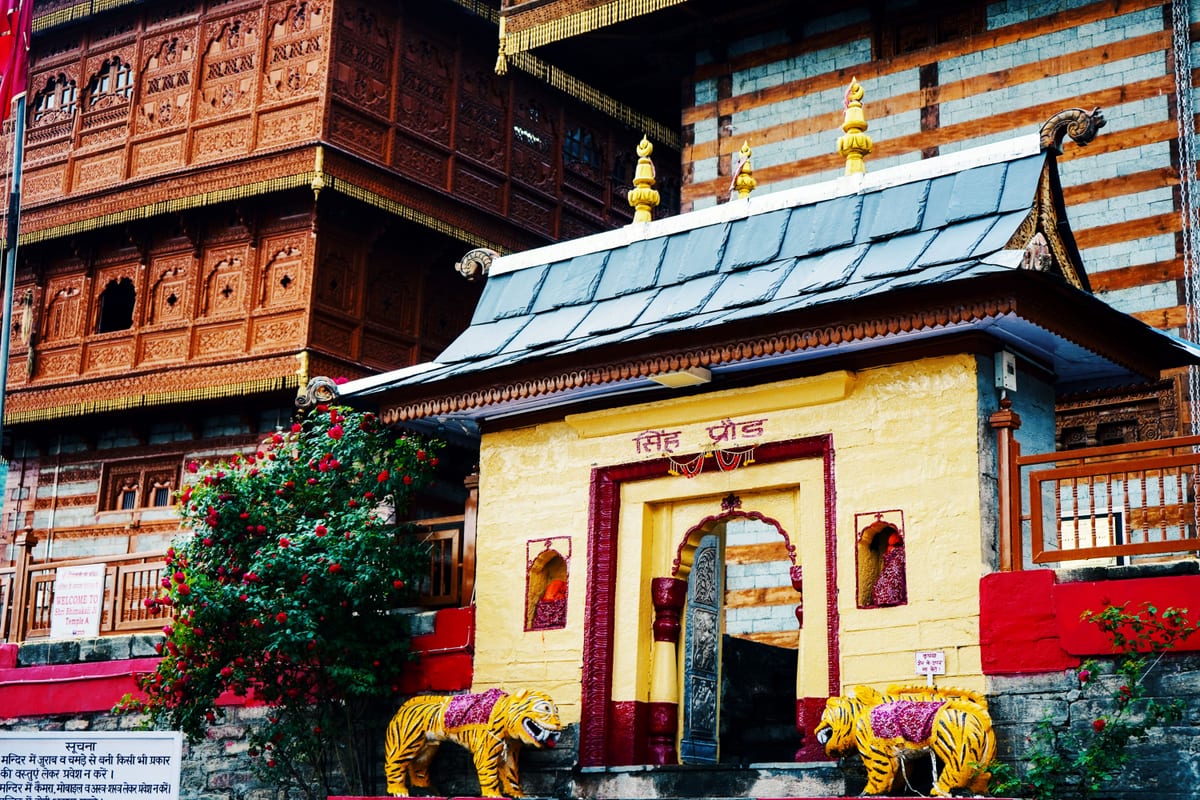
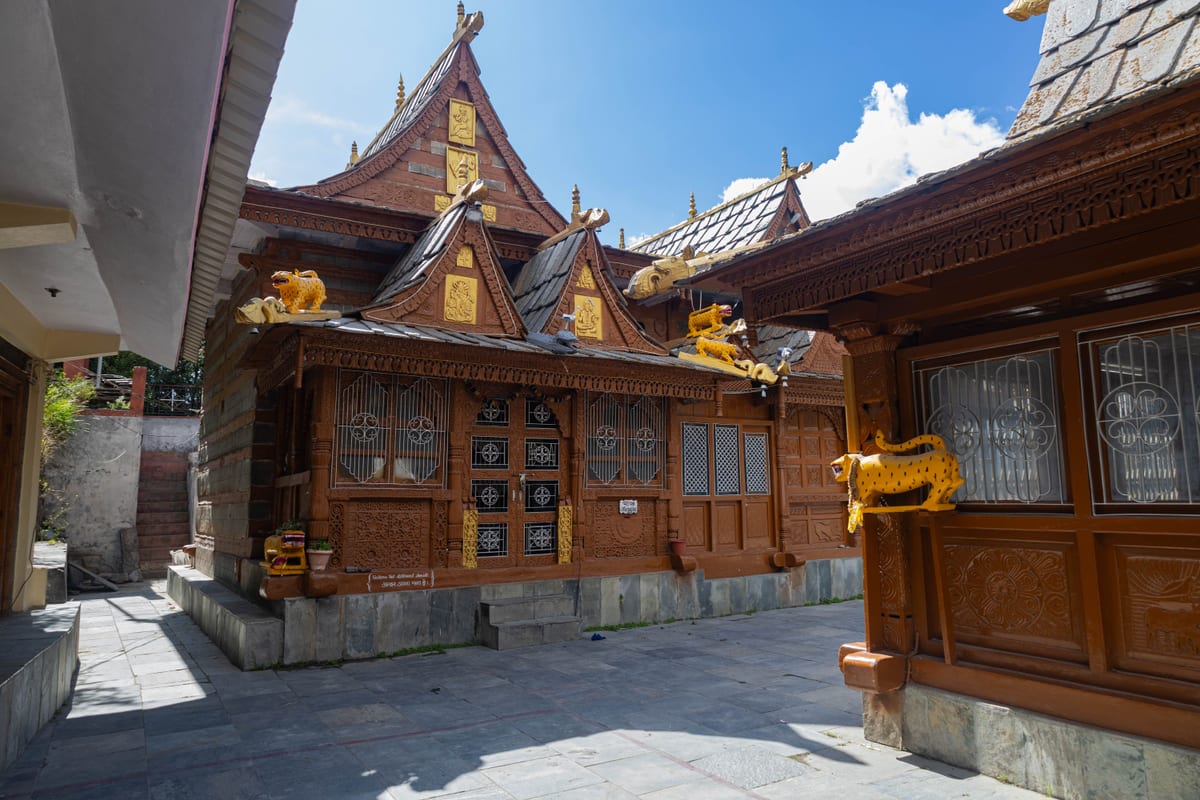
Hidimba Devi Temple was constructed in 1553 CE by Raja Bahadur Singh, the ruler of Kullu. The structure rises in four tiers, each layer smaller than the one below, culminating in a conical brass top. The lower three tiers are covered with carved wooden panels depicting animals, deities, and scenes from mythology, a visual scripture in timber. The fourth tier is sheathed in wooden shingles that have weathered to a deep silver-grey.
The entrance doorway is particularly remarkable. Its wooden frame is intricately carved with motifs of deities, animals, and foliate patterns, and over the lintel hang the horns of animals, offerings left by devotees across generations, tokens of gratitude and reverence that have accumulated into something both raw and beautiful. Inside the sanctum, there is no image of Hidimba in human form. Instead, the goddess is represented by a natural rock, a swayambhu, a self-manifested presence, which devotees touch, anoint with vermilion, and honour with flowers.
This is living worship. Not performance for visitors. Not heritage tourism dressed up as faith. The incense is real, the prayers are real, the priest is unhurried. You are witnessing something that has continued without interruption for nearly five centuries.
The Forest as Sacred Space
The temple cannot be separated from the forest that surrounds it. The deodar grove, deodar literally means 'timber of the gods' in Sanskrit, creates a cathedral-like canopy above the shrine. These trees are themselves considered sacred in the Himalayan tradition. Walking through them toward the temple, you feel the shift in atmosphere that pilgrims across cultures have described: the world slows, the noise drops away, something attentive settles over you.
The Dhungri Van Vihar, the forest park surrounding the temple complex, is managed carefully to preserve both the ecological and the sacred character of the site. This integration of environment and worship reflects India's civilisational approach, the natural world is not conquered or merely conserved, but woven into the fabric of the sacred.
When to Visit and How to Reach
The best seasons to visit Hidimba Devi Temple are May to June and September to November. The summer months bring pleasant temperatures and lush green forests after the rains, while autumn offers crisp air, golden light filtering through the deodars, and a quieter, more contemplative atmosphere. The Hidimba Devi Festival, celebrated with great fanfare in May, draws devotees from across the Kullu Valley and offers an extraordinary glimpse of the temple in its fullest cultural expression.
Manali is well connected by road. The nearest major railhead is Joginder Nagar (around 165 km away), and Chandigarh serves as the most practical rail hub for onward bus or taxi connections. The nearest airport is Bhuntar Airport (Kullu-Manali Airport), approximately 50 km from Manali, with flights connecting to Delhi. From Manali town centre, the temple is roughly 2.5 km, easily reachable by taxi, auto-rickshaw, or on foot.
Nearby Attractions
Manali rewards the curious traveller who stays a few days. The Vashisht hot springs and temple are just 3 km away and carry their own mythological weight, associated with the sage Vashisht from the Ramayana tradition. The Manu Temple, dedicated to the progenitor of humanity in Hindu cosmology, sits at old Manali village and is a site of quiet, unhurried devotion. For those interested in landscape, the Solang Valley and the approach to the Rohtang Pass offer dramatic mountain scenery in the Indian Himalaya.
Why This Place Matters
India's heritage story is sometimes told as a succession of monuments, forts, palaces, UNESCO sites, grand temples of stone. Hidimba Devi Temple reminds us that heritage is also intimate, forested, and local. It is a site where a marginalised figure from a great epic was given centre stage by the people who loved her. It is a place where the line between mythology and lived faith dissolves completely. It endures, not because it is grand, but because it is continuous.
When I finally turned to leave that October morning, a small girl was placing marigolds at the base of the carved doorway with the focused seriousness only children bring to sacred acts. The bells rang again. The deodars held their quiet. Five hundred years of devotion, and counting.