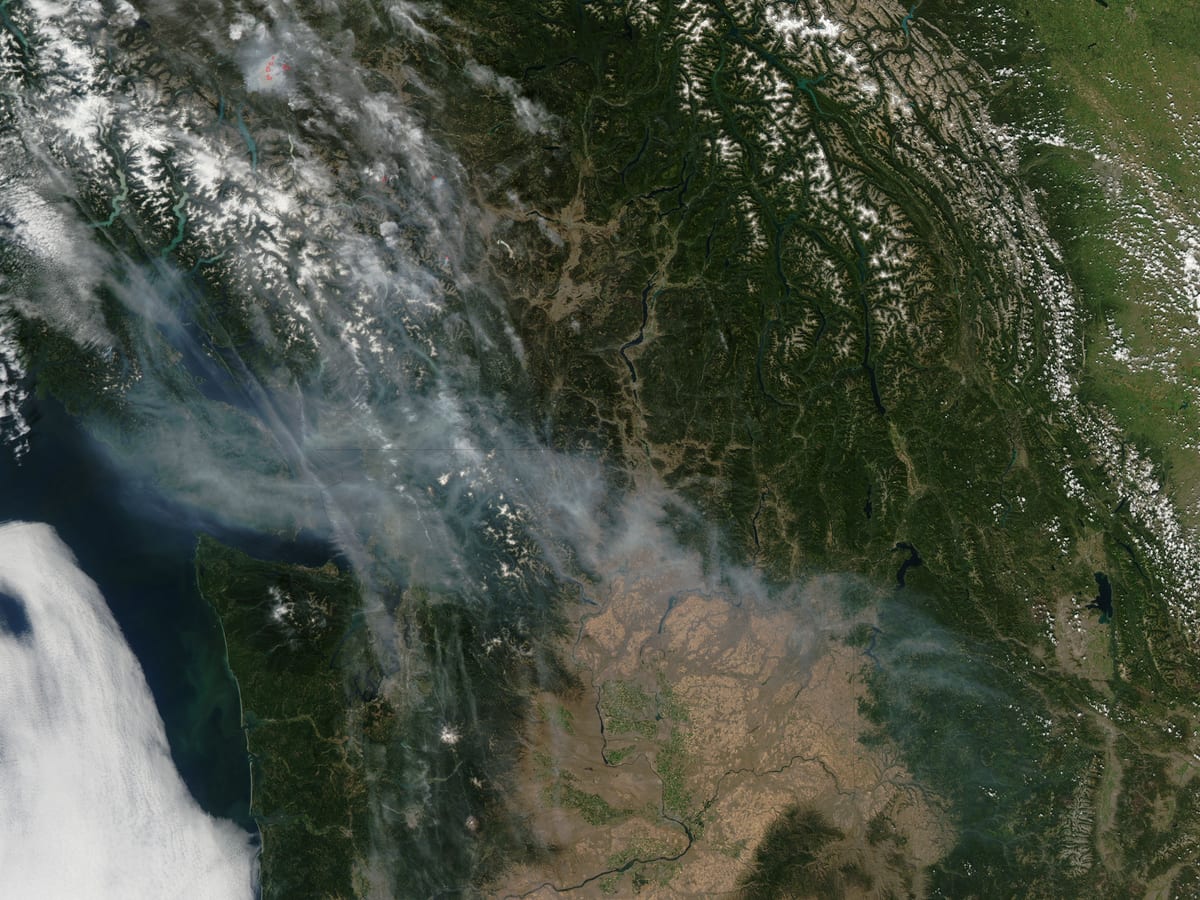
The fire is out. The satellite has moved on. The news cycle has found fresher footage. And the smoke — carrying fine particulate matter, ozone precursors, and compounds that lodge in arterial walls — drifts quietly across a dozen borders, into lungs that have no idea a forest burned three thousand kilometres away.
That is the core finding in a warning issued by the World Health Organization in late July: wildfires do not stay where they start. The smoke they generate travels across borders, and the populations at greatest risk are often not the ones watching the flames.
The WHO's framing is urgent but the insight is not new to anyone who monitors air quality across South Asia. What matters now is what governments and regional institutions do with it — and whether the warning accelerates a rethinking of how air-quality governance actually works, or simply joins the archive of advisories that changed nothing.
The Architecture of the Wrong Problem
Air-quality regulation, almost everywhere, was built to answer a 19th-century question: what comes out of that chimney? The regulatory logic follows the source — identify the polluter, measure the emission, enforce a limit. India's Commission for Air Quality Management, its State Pollution Control Boards, the graded response action plans that close brick kilns when Delhi's air turns amber — all assume that pollution has an address.
Wildfire smoke does not. It behaves like weather. It pools in valleys, rides monsoon margins, crosses mountain ranges, and arrives in cities that have no legal or institutional relationship with the fire that made it. The PM2.5 that settles over Lucknow on a November morning may carry carbon from a forest fire in Uttarakhand, agricultural stubble from Punjab, or — in years when wind patterns cooperate — biomass burning from as far as Myanmar or Indonesia. No single regulator owns that mixture. No single action plan addresses it.
Dr. Sagnik Dey at IIT Delhi's Centre for Atmospheric Sciences has documented how biomass burning across South and Southeast Asia compounds India's particulate burden, and has argued for a regional smoke-monitoring protocol under existing multilateral frameworks. The observation points to a genuine institutional gap: India has the satellite infrastructure — ISRO's fire-hotspot detection feeds real-time alerts to state governments — but the downstream health-response architecture stops at the state boundary. A downwind district in Bihar has no formal mechanism to receive an advisory calibrated to smoke arriving from a fire in Himachal Pradesh.
What 4,500 Fires in One Season Tells You
The scale of India's own wildfire exposure clarifies why the WHO advisory matters. Uttarakhand recorded over 4,500 forest-fire incidents in the 2024 fire season, a figure that sits alongside the seasonal stubble-burning cycle in the north Indian plains to produce the air-quality collapse that descends on the Indo-Gangetic belt each October and November. Delhi-NCR's Air Quality Index routinely enters 'severe' territory during these months — a category that means outdoor air is unsafe for every population group, not just the vulnerable.
The health burden is not a projection. The State of Global Air 2024 report estimated that air pollution contributes to approximately 1.67 million premature deaths annually in India. That number encompasses the full pollution mix — industrial, vehicular, fire-sourced — but the wildfire and biomass-burning contribution is substantial and distinct. It responds to different interventions than diesel exhaust does. A clean cooking fuel scheme reduces one kind of PM2.5 exposure; it does nothing for smoke from a forest fire burning at altitude in a drought year.
This is the precise distinction that Anumita Roychowdhury at the Centre for Science and Environment has pressed for years: India's air-action plans treat pollution as a unified problem when it is, in fact, several overlapping problems that require separate policy instruments. The WHO warning, by elevating wildfire smoke as a category requiring specific health-system responses, supports that argument.
The Governance Gap That Travels Across Ministries
Any honest accounting of India's wildfire-smoke challenge runs into a coordination problem that is not unique to India but is particularly acute given the scale of exposure. Responding to agricultural stubble burning requires the Agriculture Ministry. Managing forest fires falls to the Ministry of Environment, Forest and Climate Change, and in practice to state forest departments with uneven capacity. The health consequences land on the Ministry of Health and Family Welfare. Early warning infrastructure sits with ISRO and the Ministry of Earth Sciences. Air-quality enforcement is split between CAQM — which covers the National Capital Region — and state boards elsewhere.
No single architecture connects these actors for the specific purpose of wildfire-smoke health preparedness. When a large fire burns in Uttarakhand, there is no standardised mechanism by which a CAQM-style health advisory reaches hospitals in Agra or Kanpur calibrated to incoming smoke load, allowing them to prepare for a surge in respiratory presentations. The fire is tracked. The smoke is modelled. The health-system response is improvised.
A 2023 Parliamentary Standing Committee report noted that India's Forest Survey data underreports fire-affected area due to cloud-cover limitations in optical satellite imagery, recommending a shift to SAR-based monitoring. That recommendation points to a broader truth: the measurement of the problem and the governance of its consequences are both incomplete, and they operate within different ministries.
A Regional Opportunity India Could Shape
The WHO advisory creates a moment — if India moves with purpose — to position its existing fire-detection infrastructure as a regional public good. ISRO's VIIRS-fed hotspot alert system is advanced. The WMO-WHO Joint Office for Climate and Health has been building frameworks for exactly this kind of transboundary climate-health risk. A South and Southeast Asia Wildfire Smoke Early Warning System, anchored in part to Indian satellite data and coordinated through WMO-WHO channels, would serve India's immediate interests — better regional data on incoming smoke — while advancing a diplomatic argument India has made consistently in multilateral health forums: that air-quality interventions must account for development context, and that technology-transfer obligations must accompany health mandates.
India's engagement with WHO on air quality has been described by the Observer Research Foundation's health-diplomacy programme as underweighted relative to the country's disease burden. The wildfire smoke advisory is an opening to correct that imbalance. India has monitoring infrastructure, atmospheric science expertise, and a domestic policy programme already targeting significant reductions in PM2.5 concentrations. That positions India as a country that shapes global air-quality governance, not one that receives it.
The Smoke Doesn't Wait for the Institutional Fix
There is a gap between what India's air-quality system was designed to do and what wildfire smoke requires of it. That gap is not a failure of ambition — India's National Clean Air Programme represents genuine policy seriousness — but of architecture. The NCAP was designed around stationary sources in a regulatory tradition that rewards identifying the chimney. Wildfire smoke is the chimney's opposite: sourceless from a regulatory standpoint, borderless in its movement, and seasonal in a pattern that is shifting as fire seasons lengthen under warming conditions.
The WHO warning is a prompt to ask whether a country that already carries one of the world's heaviest air-pollution burdens can afford to manage its fastest-growing component — transboundary fire smoke — with institutions built for a different era of pollution. The answer will not come from a single advisory, however authoritative. It will come from whether India's health, environment, agriculture, and forest ministries can build a coordination architecture that treats smoke as the mobile, cross-jurisdictional hazard it actually is — and whether India's diplomats use the WHO moment to place India at the centre of the regional early-warning infrastructure that the Indo-Gangetic basin already needs.