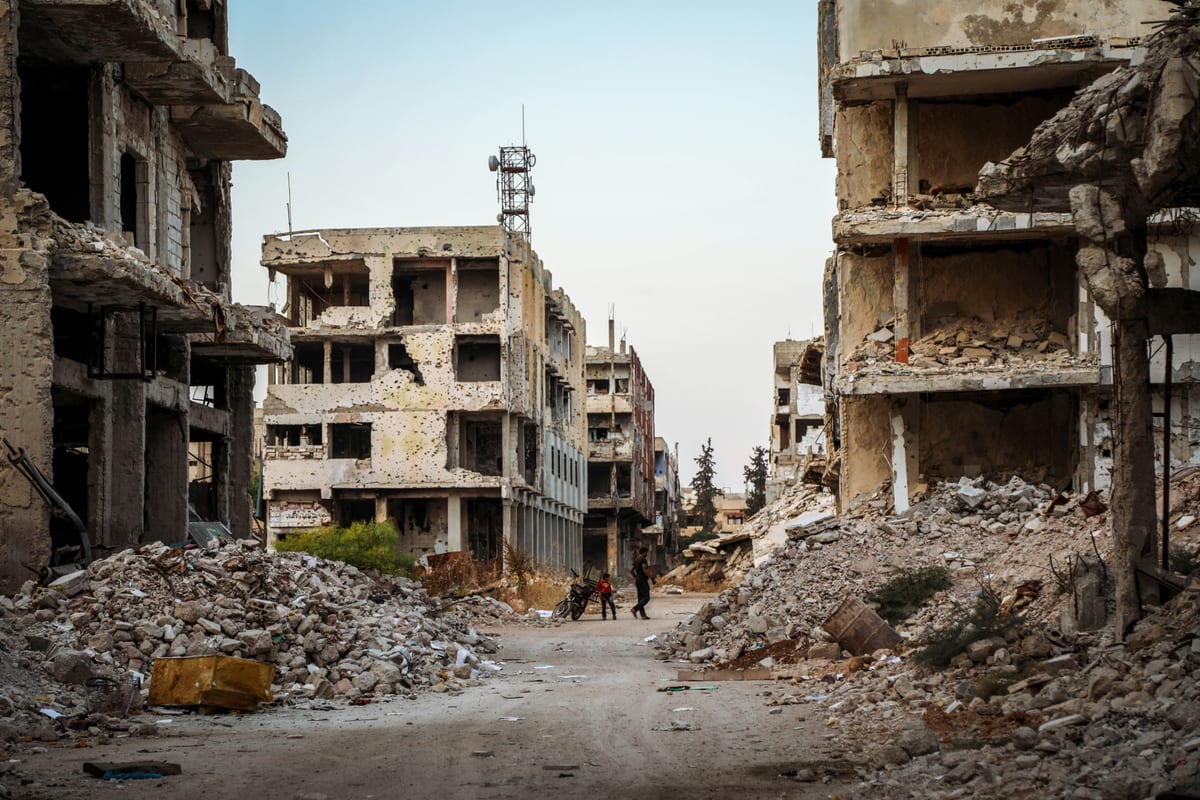
A mosque in Gaza was struck by Israeli forces, which claimed the site served as a Hamas weapons depot — a justification that has become one of the most contested formulae of this war. The strike occurred while a ceasefire nominally remains in place, the same truce that has not, by any meaningful measure, halted the killing: more than 1,200 people have died in Gaza since the October 2025 truce began. The geometry of this conflict has not changed — a paper ceasefire, recurring strikes, competing claims about military necessity, and civilian infrastructure at the centre of each cycle. What is changing, slowly and with consequence, is the cost that this geometry imposes on actors far from the rubble, including New Delhi.
The Ceasefire That Isn't
A ceasefire that does not cease fire has a specific cruelty. It is worse, in some ways, than open war — it creates the legal and diplomatic fiction of peace while delivering the material reality of bombardment. The mosque strike fits this pattern precisely: Israel exercises military discretion within a truce framework, Hamas retains operational infrastructure within civilian sites, and the international community issues statements that have no enforcement mechanism. More than 1,200 dead since the truce began is not a ceasefire; it is war conducted under a different administrative heading.
The claim that Hamas used the mosque for weapons storage is not inherently implausible — the group has demonstrably used civilian infrastructure for military purposes throughout the conflict. Equally, the pattern of Israeli strikes on mosques, hospitals, and schools has been documented with a frequency that makes case-by-case military necessity arguments difficult to evaluate from the outside. Neither observation resolves the other. What both observations together produce is a conflict in which civilian spaces have been so thoroughly militarised by one party and so systematically targeted by the other that the category of protected site has become nearly inoperative.
The UN Security Council cannot enforce ceasefire terms — a theme that surfaced in a July 2025 Council debate on preventive diplomacy. The enforcement gap is not incidental to this ceasefire's failure; it is architectural. States that want peace in Gaza cannot simply declare it. They need mechanisms, and those mechanisms require political will that the P5 structure consistently fails to generate.
Where India Sits in This Geometry
India has maintained what External Affairs Minister S. Jaishankar has described as a principled dual-track posture: zero tolerance for terrorism, support for Israel's right to self-defence, simultaneous backing for Palestinian statehood, and consistent calls at the UN for humanitarian pauses and civilian protection. This is not a contradiction, even if Western commentators habitually frame it as one. It is a deliberate assertion that New Delhi will not be instrumentalised by either the American-Israeli axis or the Organisation of Islamic Cooperation into a declaratory position that serves someone else's strategic needs.
Harsh V. Pant of the Observer Research Foundation has argued that this dual-track posture is strategically coherent precisely because it reflects India's refusal to subordinate national interest to any bloc's normative framework. Sushant Sareen, also at ORF, has characterised India's calibrated UN votes on Gaza resolutions as a deliberate signal to both Washington and the Arab League — a message that New Delhi will engage, but on its own terms. This reading is correct as far as it goes. The difficulty is that tactical coherence and strategic ambition are not the same thing, and the gap between them is where India currently stands.
The arithmetic is straightforward. India imports approximately 85 percent of its crude oil. Its vast diaspora workforce across Gulf Cooperation Council states sends home remittances that stabilise millions of households. Any resumption of full-scale conflict in Gaza — and the mosque strike, occurring under a nominal ceasefire, raises precisely that risk — would push Brent crude prices upward at a moment when the Reserve Bank of India is navigating a delicate rate environment. Inflationary pressure from energy costs is not an abstraction in Delhi's South Block; it is a variable in every macroeconomic projection for the current fiscal year.
The Reconstruction Window and Why Silence Has a Price
There is a second calculus, less discussed but more strategically significant for India's longer arc. Prime Minister Modi signalled at UNGA 2024 that India has an interest in contributing to Gaza's post-conflict reconstruction. That signal was read in Gulf capitals, in Ramallah, and in Tel Aviv. It was a serious piece of diplomatic positioning — the kind that converts humanitarian advocacy into economic presence.
That window requires a durable ceasefire to open. Every mosque strike under a nominal truce, every week in which 1,200 deaths accumulate beneath a peace agreement's banner, shrinks that window. It also cedes narrative space. The OIC issues statements. Western governments issue statements. India issues statements. But statements are not enforcement, and enforcement is not something any of these actors is currently supplying. The actor that moves from statements to mechanism-building — that uses back-channel relationships with both Israel and key Arab states to push for genuine ceasefire enforcement rather than ceasefire nomenclature — will occupy a different order of diplomatic real estate than the actors simply registering concern.
India has the relational infrastructure to attempt this. The I2U2 framework — connecting India, Israel, the UAE, and the United States — is precisely the kind of multi-vector architecture through which a proposition about ceasefire enforcement could travel. The UAE and Saudi Arabia have their own compelling reasons to want Gaza stabilised; Gulf states hosting the Indian diaspora cannot afford a regional escalation any more than New Delhi can. The alignment of interests exists. The question is whether the diplomatic machinery activates it or continues to produce calibrated abstentions.
The Mosque, the Optics, and the Domestic Dimension
There is a dimension of this strike that Indian policymakers will calculate privately even if they do not state it publicly. The targeting of a mosque — whatever its military justification — generates a specific set of images that circulate across the Muslim world, including among India's own substantial Muslim population. Former MEA Secretary Pinak Ranjan Chakravarty has noted that India's Gulf diaspora makes prolonged Middle East instability a direct consular and economic risk that tends to be underestimated in strategic analyses focused on energy markets alone. The social dimension — how recurring imagery of mosque strikes in Gaza reads domestically — is part of the same risk calculus, even if it inhabits a different register.
This does not mean India should or will alter its dual-track posture in response to any individual strike. It means the cumulative cost of that posture is not purely external. Every cycle of ceasefire-and-strike that New Delhi observes without deploying its relational assets toward enforcement adds a small increment to a domestic political sensitivity that is already nonzero. The strategic logic of the dual-track position remains sound; the tactical question is whether silence on specific incidents like this one — which Indian MEA has not addressed — continues to serve that logic or begins to hollow it out.
C. Raja Mohan has written that India's deepening defence cooperation with Israel in drone and missile systems technology means New Delhi has a material stake in Israeli security that purely humanitarian framing obscures. That is true. It is equally true that a Gaza which smoulders indefinitely through recurring nominal ceasefires is not in Israel's long-term security interest, is not in India's energy or diaspora interest, and is not in the Gulf states' stability interest. The convergence of these interests around a genuine enforcement mechanism for peace is the argument India is positioned to make — but only if it moves beyond the declaratory register in which it currently operates. The mosque will be rebuilt or it will not. What India builds from this moment is the more consequential question.