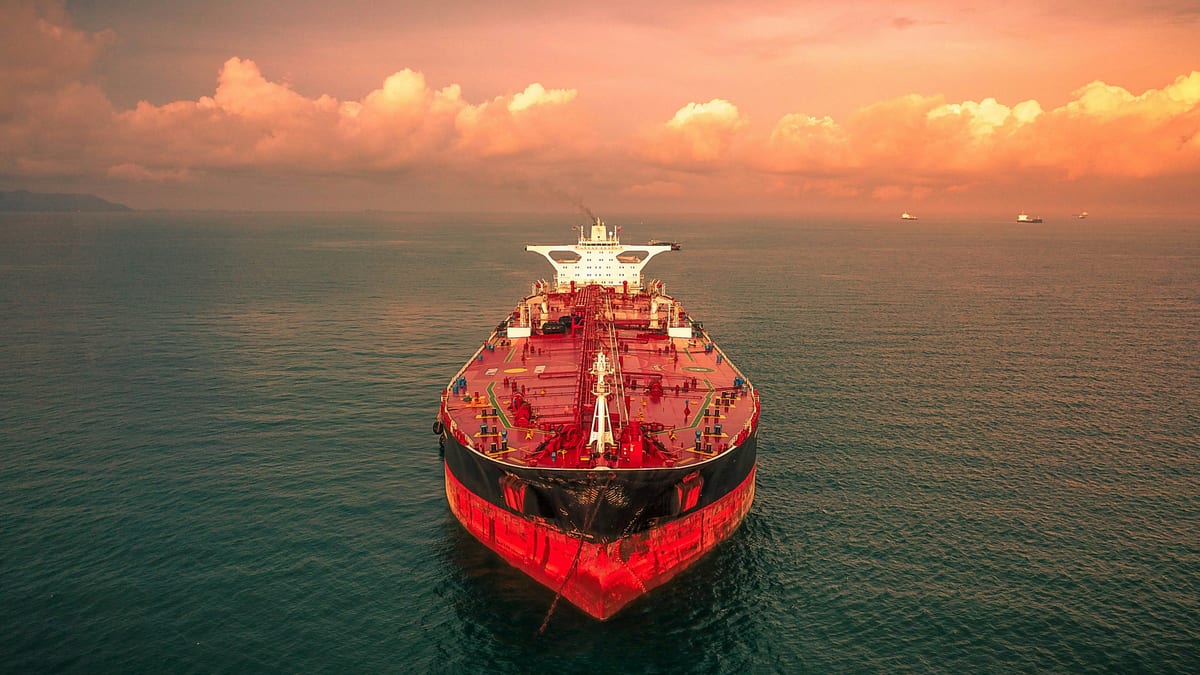
The Strait of Hormuz is twenty-one miles wide at its narrowest point. Through that channel moves roughly a fifth of the world's traded oil. On the morning of July 23, that corridor was simultaneously a theatre of US air operations against Iranian targets and a hunting ground for Houthi missiles aimed at Saudi tankers in the Red Sea. US President Donald Trump had threatened to destroy an Iranian bridge or power plant for every attack on Gulf shipping, drawing an eye-for-an-eye warning from Tehran. Both sides were sharpening threats rather than exits.
For most of the world, this registers as another chapter in the long antagonism between Washington and Tehran. For New Delhi, it is something considerably more visceral—a structural threat to the two maritime corridors through which the overwhelming bulk of India's crude oil travels, arriving at refineries that feed a $3.5 trillion economy and fuel the cooking stoves, trucks, and power plants of 1.4 billion people.
The Corridor That Cannot Be Replaced
India imports approximately 85% of its crude oil. A significant share of those barrels originates in the Gulf—Saudi Arabia, Iraq, the UAE, Kuwait—and every one of them must pass through or near the Strait of Hormuz before entering the Indian Ocean. The Red Sea route, where Houthis have now resumed attacking Saudi tankers, is the secondary corridor connecting West Asian suppliers to Indian west-coast ports. When both arteries are under simultaneous military pressure, the arithmetic for Indian refiners turns brutal: longer alternative routes around the Cape of Good Hope, higher freight rates, steeper insurance premiums, and Brent crude prices that surge before the first alternative barrel even arrives.
There is no easy detour. West African and Latin American crude can partially substitute Gulf barrels on the spot market, but the logistics require weeks to reroute and the price premium is immediate. India's strategic petroleum reserves offer a buffer, but they are a finite shock absorber, not a replacement supply chain. Commodore Uday Bhaskar (retired), Director of the Society for Policy Studies, has argued that a Hormuz closure is an existential energy-security event, not merely a market disruption. It warrants activating reserve drawdown protocols at the first sign of sustained interdiction rather than waiting for the price signal to become undeniable.
The Indian Navy already operates in the Gulf of Aden on anti-piracy missions. Those assets now navigate a threat environment transformed by Houthi anti-ship missiles—weapons with considerably more range and terminal accuracy than the small-boat tactics that defined the earlier piracy era. The strategic geography that made the Indian Navy's Gulf of Aden presence an assertion of blue-water ambition now makes it a risk-management calculation.
Chabahar: The Strategic Bet That War Can Erase
India's exposure in this crisis goes beyond crude oil flows. The Chabahar port project is India's only sovereign maritime foothold in the Iranian littoral. It represents a decade of diplomatic effort asserting that New Delhi's connectivity ambitions in Central Asia required a route that bypassed Pakistan. The port anchors the International North-South Transport Corridor, the trade highway that India envisions running through Iran and up through Azerbaijan and Russia to European markets, providing an alternative to Chinese-dominated overland routes.
Active US strikes on Iranian infrastructure do not merely threaten Chabahar physically. They create a sanctions environment in which every contractor, shipping company, and financial institution involved in the port's operations must weigh US Treasury exposure against project participation. The port holds a statutory exemption from US sanctions—a recognition, secured after years of diplomatic effort, that Chabahar serves regional stability interests that Washington itself has acknowledged. But statutory exemptions and operational reality diverge during active hostilities. The question is not whether the exemption exists on paper; it is whether any international bank will process a Chabahar-related transaction while US aircraft are striking Iranian territory.
Former Foreign Secretary Shyam Saran has argued that India's Chabahar investment is a strategic asset that cannot be abandoned under US pressure without forfeiting the broader connectivity architecture that underpins India's Central Asia ambitions. That argument is correct. It also defines the problem: New Delhi must hold the line on an investment whose operational context has just deteriorated from diplomatically complex to militarily hazardous.
Eight Million People and the Remittance Question
The human dimension of the Gulf crisis rarely enters the strategic calculus until it becomes impossible to ignore. Roughly 8 million Indian nationals live and work across the Gulf states—in the UAE, Saudi Arabia, Kuwait, Oman, Qatar, and Bahrain. Their remittances, exceeding $40 billion annually, represent one of India's largest sources of foreign exchange, a flow that quietly stabilises the current account and supports household consumption across Kerala, UP, Rajasthan, and Tamil Nadu. A regional war that displaces workers, shuts down construction sites and service industries, or simply triggers an evacuation wave would collapse that flow at precisely the moment India's import bill is spiking.
The Gulf diaspora is not an abstraction. These are workers who left home to fund a daughter's education or repay a farm loan. Their exposure to a conflict they had no hand in shaping is the human face of the geopolitical risk that analysts measure in barrels and basis points.
New Delhi's Diplomatic Architecture—and Its Limits
India has not issued a formal MEA statement on the current escalation, consistent with its longstanding posture of not taking sides in US-Iran confrontations. This silence is not confusion; it is policy. New Delhi maintains functional relationships with both Washington—through the Quad, defence co-production agreements, and technology partnerships—and Tehran, through Chabahar and the energy trade. Taking sides would sacrifice one relationship without securing the other.
But studied silence has diminishing returns when the infrastructure underpinning both relationships is under active threat. Harsh Pant of the Observer Research Foundation has argued that India possesses a rare asset in this crisis: access to both capitals that neither European powers nor Gulf states fully replicate. The question is whether New Delhi uses that access passively—waiting for the shooting to stop—or actively, framing the protection of civilian shipping lanes and commercial corridors as a global commons issue that neither belligerent has the right to close unilaterally.
Former Secretary (East) Anil Wadhwa has made the related point that India's non-aligned positioning gives it a channel to communicate red lines to Tehran that Western intermediaries cannot credibly carry. If India wants the Chabahar exemption to survive this conflict operationally, not just legally, it needs to be making that case in Tehran as well as Washington—and doing so before the strikes and counter-strikes harden positions to the point where no intermediary's voice penetrates.
The Calculus of Strategic Autonomy
The deeper lesson of the Hormuz crisis is one that India has absorbed in slow motion for a decade: strategic autonomy is not merely a diplomatic posture. It requires infrastructure that is not held hostage by any single corridor, any single supplier, or any single bilateral relationship. The INSTC through Chabahar was meant to reduce that hostage dynamic. The aggressive push toward domestic energy production, green and conventional, was meant to reduce it further. Every barrel of domestically produced renewable energy is a barrel that does not have to transit the Strait of Hormuz.
None of that infrastructure is ready yet. India's renewable energy buildout is genuine and accelerating, but the economy's petroleum dependence will not fall to manageable levels within any timeframe relevant to the current crisis. The strategic petroleum reserves provide a bridge, not a solution. The spot market in West African and Latin American crude provides diversification, not independence.
What the Hormuz escalation clarifies is that India's energy-security architecture has a single-point-of-failure problem that no amount of diplomatic elegance can paper over. The Strait of Hormuz is twenty-one miles wide. Indian foreign policy can be sophisticated across a hundred dimensions and still find itself exposed by twenty-one miles of water that two hostile parties are treating as their private battlefield. The work of building genuine strategic depth in energy, connectivity, and diaspora protection is not a medium-term ambition. It is the most urgent infrastructure project India is running, whether the government frames it that way or not.