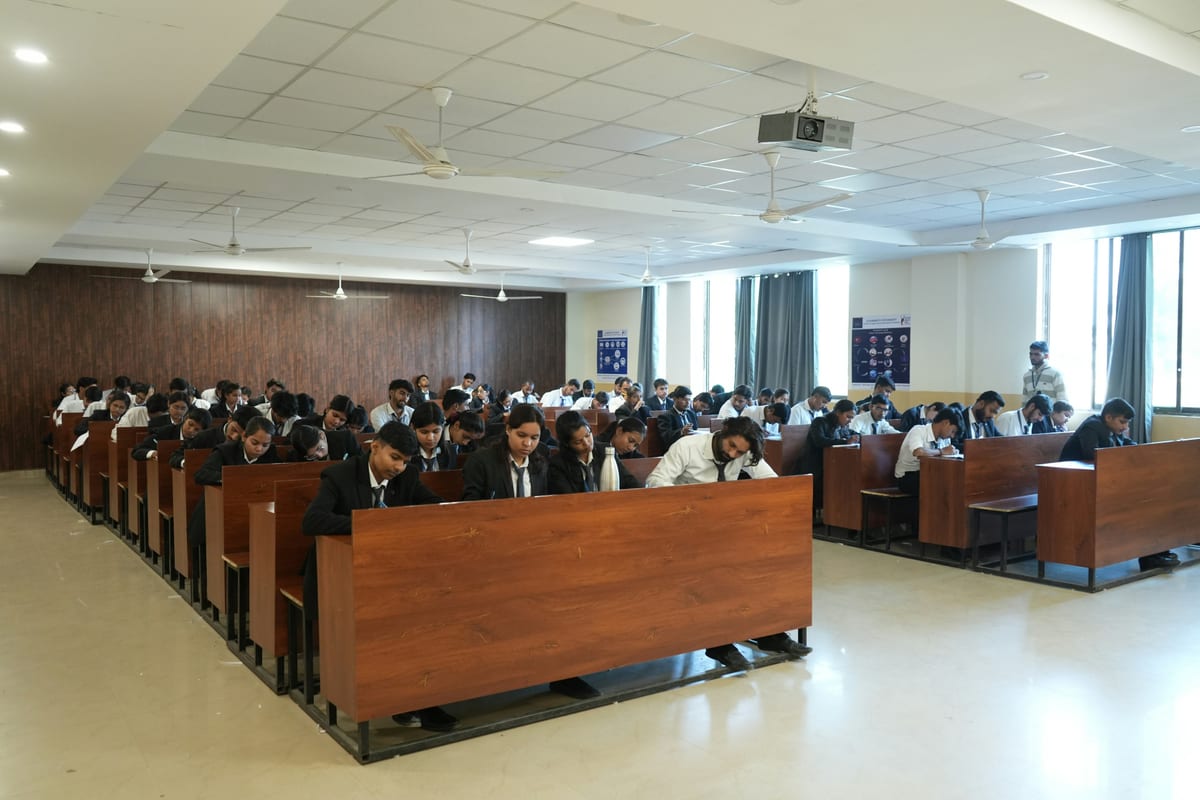
On Thursday, Union Minister Jitendra Singh moved the Public Examinations (Prevention of Unfair Means) Amendment Bill, 2026, in the Rajya Sabha — a day after the Lok Sabha cleared it following ten hours of debate marked by what Singh described as frequent interruptions. The bill's rapid passage through both houses carries a message beyond its penal provisions: the government treats examination fraud not as an administrative irregularity but as a criminal conspiracy warranting the full weight of state machinery.
The scale of the escalation is substantial. Under the 2026 amendments, individuals resorting to unfair means face imprisonment of five to ten years, up from three to five — and fines rising from Rs 10 lakh to Rs 50 lakh. Service providers implicated in examination offences now face a maximum fine of Rs 5 crore, against Rs 1 crore, and debarment from conducting public examinations for eight years rather than four. Organised crime syndicates operating in the examination space — the paper-leak mafias that have industrialised fraud across multiple states — now attract imprisonment of seven to ten years and a maximum fine of Rs 10 crore. Directors and senior management of service providers face five to ten years in prison, up from three to ten, with maximum fines scaled to Rs 5 crore. The LiveMint's account of the Rajya Sabha introduction noted the bill arrived amid Opposition uproar, with Congress and allied parties arguing that the amendment itself concedes the inadequacy of the 2024 original.
That charge is not without foundation — but it is not the damning indictment the Opposition intends. Legislation that learns from implementation is a mark of institutional maturity, not institutional failure. Singh acknowledged this directly: the amendments reflect the government's willingness to learn from the 2024 law's operation. The question is not whether the first law was perfect, but whether the state is closing the gap between statute and syndicate fast enough to matter.
The Architecture of Deterrence
Three structural additions in the Amendment Bill merit closer attention than penalty numbers alone. First, the bill provides for Special Fast Track Courts dedicated to public examination offences, with investigation completion mandated within two months and trial completion within three months from charge sheet filing. In a justice system where economic offences routinely languish for years, this compressed timeline represents a genuine departure. Swift, visible punishment is the only deterrence that reaches the paper-leak ecosystem, where syndicates currently profit from a single leaked examination at scale. Criminal networks can absorb conventional fines and legal fees; they cannot absorb the reputational and operational shock of rapid conviction.
Second, the bill provides for the appointment of Special Public Prosecutors for these offences — an implicit recognition that prosecution quality has been as much a bottleneck as investigation. Examination fraud cases typically involve digital forensics, financial trail reconstruction, and testimony from disparate actors across multiple states. A generalist public prosecutor with an overwhelming caseload is poorly equipped to handle them. Specialisation at the prosecution stage acknowledges that the state's courtroom capability must match its investigative ambition.
Third, the bill empowers the government to constitute a Special Task Force for investigation. Existing police and enforcement structures, subdivided by state jurisdiction, are structurally mismatched against syndicates that operate across state lines and involve coaching institutions, printing contractors, examination conducting agencies, and corrupt intermediaries in a distributed network. A central task force with cross-jurisdictional reach is the appropriate instrument; its constitution should be treated as urgent.
The Single-Point Failure Problem the Law Alone Cannot Solve
The 2024 NEET-UG paper leak exposed something the penal code cannot fully address: the structural concentration of examination delivery in single agencies creates catastrophic single points of failure. When one breach compromises an examination that millions of aspirants have spent years preparing for, the damage to public trust is not merely proportional to the fraud's scale — it is exponential, because the harm falls on people with no alternative route and no recourse.
India's high-stakes examination architecture — covering civil services, medical admissions, banking recruitment, staff selection, and dozens of state-level equivalents — concentrates enormous power and extraordinary temptation through a narrow institutional corridor. The coaching industry surrounding this corridor is an economy worth thousands of crores, with financial incentives aligned toward information asymmetry rather than examination integrity. Pratap Bhanu Mehta, writing after the NEET crisis, characterised paper leaks as symptoms of a procurement and contracting culture that structurally incentivises fraud rather than isolated acts of individual corruption. That diagnosis points beyond the penal statute.
What the Amendment Bill does well is signal zero tolerance at the top of the political hierarchy. Singh's address in the Rajya Sabha invoked Prime Minister Modi's stated commitment to protecting student futures and the government's declared policy of no compromise on examination integrity. Political signal matters in deterrence architecture — it shapes how subordinate agencies and private contractors calibrate their own risk calculations. But signal must be followed by systemic redesign: end-to-end digitisation of question paper distribution, independent forensic auditing of examination processes, and distributed delivery infrastructure that eliminates the single-vendor dependency that makes catastrophic breach possible.
Meritocracy as Governance Infrastructure
The political argument for examination integrity is usually framed around fairness to aspirants — and it should be. Aspirants from Tier-3 cities and rural districts who spend years on competitive preparation, funded by family sacrifice, suffer a particular and irreversible harm when the examination they prepared for is compromised. Unlike candidates from well-networked families with alternative pathways, these aspirants have placed their entire bet on the system's integrity. When that bet is stolen, it destroys an individual opportunity and delivers a verdict on the social contract itself.
But there is a second argument, less discussed and equally serious. India's aspiration of building a merit-based civil service and skilled workforce — central to the Viksit Bharat 2047 architecture — rests on the credibility of the credentialling mechanisms that sort talent. A bureaucracy populated through compromised examinations is not merely an ethical failure; it is an efficiency failure, allocating administrative authority to people selected by bribe rather than ability, with compounding consequences for every public institution they touch. The paper-leak syndicate robs individual aspirants and degrades the human capital pipeline of the Indian state.
Internationally, the credential recognition that underlies India's export of skilled professionals — engineers, doctors, technology workers, finance professionals — depends, at least partially, on the global standing of Indian examination systems. Repeated high-profile failures corrode that standing over time.
The Amendment Bill's swift passage through both houses suggests legislative consensus that the original framework was undergunned. The Opposition's demand for a comprehensive review of the National Testing Agency and the examining bodies that conduct these tests is not incompatible with the government's legislative trajectory; it is the necessary complement. Criminal deterrence reduces the incentive to cheat; institutional redesign reduces the opportunity. Both are required, and the bill addresses only the first. Whether the Special Task Force and Fast Track Courts, once constituted, become durable instruments of examination security or episodic responses to political pressure is the question that will determine whether 2026 marks a genuine inflection or another entry in the cycle of scandal and legislative reaction that has characterised the last two years.