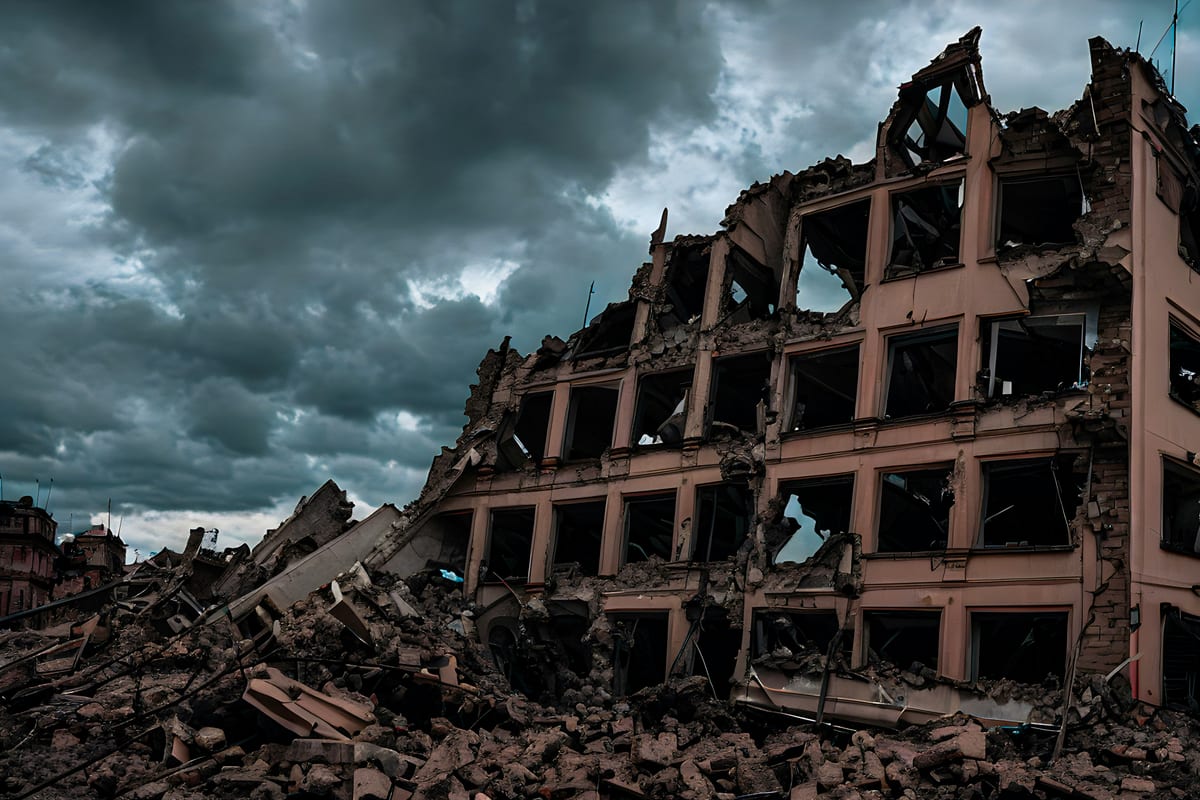
Russian missiles and drones struck Kyiv overnight on Sunday, killing at least 14 civilians and wounding more than 80, according to local Ukrainian authorities. The attack, reported by UN News, targeted residential areas of the Ukrainian capital — apartment blocks, not military installations. By morning, rescuers were pulling survivors from rubble in neighbourhoods that have endured this kind of night dozens of times over the past four years.
The strike comes at a moment when ceasefire negotiations, intermittently signalled by various intermediaries, have produced nothing durable. The war has outlasted predictions, diplomatic frameworks, and the patience of most of the world. For India, which has held its diplomatic footing with unusual care throughout this conflict, the Kyiv assault raises a question that can no longer be deferred: what does principled non-alignment actually produce when the killing continues at this pace?
The Lane Modi Opened
When Prime Minister Modi flew into Kyiv in August 2024 — the first visit by an Indian prime minister to Ukraine since the two countries established relations — the symbolism was deliberate. It followed his visit to Moscow. The sequencing was not accidental. New Delhi was demonstrating that it speaks to both capitals, that it is not a party to the conflict, and that it carries a message rather than merely an abstraction. Modi's formulation from Samarkand in September 2022 — that this is not an era of war — had already established India's rhetorical marker. The Kyiv visit translated that rhetoric into a physical presence.
That visit created what analysts at Carnegie India have described as a new diplomatic lane for India — a channel through which New Delhi could, if it chose, serve as a back-channel conduit between parties who no longer speak directly to each other. The lane exists. The question, more pressing after each strike like Monday's, is whether India will use it or let it narrow by disuse.
Harsh V. Pant at the Observer Research Foundation has argued that India's abstentions at the UN Security Council and General Assembly reflect a calibrated reading of multipolarity, not moral ambiguity. That is a defensible position in diplomatic theory. But calibration requires active management. Silence after 14 civilians die in Kyiv is not calibration — it is drift. The distinction matters enormously to the Global South audience India is simultaneously courting as a credible peace voice.
What Reconstruction Has to Do With Rubble
There is a harder commercial logic running beneath the humanitarian one, and it deserves to be stated plainly. India has signalled interest in Ukraine's post-conflict reconstruction. Modi's Kyiv visit included discussions on economic cooperation. Indian industry has tracked reconstruction tenders with attention. The logic is sound: Ukraine will require an enormous rebuilding effort whenever hostilities end, and India has both the engineering capacity and the motivation to participate.
Every strike on Kyiv's residential infrastructure destroys that opportunity twice over. First, it adds to the reconstruction bill, pushing the eventual project further beyond near-term reach. Second, it signals that the ceasefire horizon remains distant — and no serious reconstruction contract gets signed while missiles still fall. Indian firms do not invest in active war zones. The commercial case for peace, from New Delhi's vantage point, is concrete.
This is the structural fault-line that analysts working on India's Ukraine positioning have been circling. India's discounted Russian oil trade — which has grown substantially since Western sanctions redirected Russian crude toward Asian buyers — generates real economic value. No serious Indian policymaker proposes abandoning it. But that trade and India's ambition to be a recognised peace mediator are beginning to pull in opposite directions as the conflict deepens and Western partners grow more pointed in their observations about Indian purchasing patterns. The tension is not yet acute enough to force a rupture, but it compounds with each passing month of war.
The MEA's Next Statement
India's Ministry of External Affairs has, across multiple rounds of escalation, condemned civilian casualties without attributing direct responsibility in formal statements. The formulation is carefully worded, preserving India's non-aligned posture while signalling humanitarian concern. It is diplomatically precise. It is also, by now, entirely predictable — and predictability in diplomacy signals that a country has run out of moves.
Happymon Jacob at the Council for Strategic and Defence Research has written that India's Ukraine policy is coherent but under-communicated — that New Delhi has a genuine peace framework but relies on studied silence where it should be articulating positions. The observation cuts close. A country that wants to be taken seriously as a peace interlocutor cannot afford to communicate only through abstentions and carefully hedged condolence statements. At some point, it must say something specific about what peace should look like and what India is prepared to do to advance it.
The cost of a more direct MEA statement — one that names the civilian death toll in Kyiv and calls for an immediate halt to strikes on residential areas — is low. It costs India nothing strategically. Russia understands that India operates from sovereign interest, not Western-directed pressure. Such a statement would not rupture the energy relationship or the military-technical cooperation that India values. What it would do is reinforce India's humanitarian credentials at a moment when the Global South is watching whether large powers actually mean what they say about protecting civilians.
The Grain Corridor and the Cost of Distance
The war's effects reach India through less visible channels as well. Black Sea grain corridors — whose disruption since 2022 has sent ripples through global food commodity markets — affect the import costs of countries that buy wheat and sunflower oil from the region. India, which imports edible oils in significant volumes, has felt the inflationary pressure of sustained commodity volatility. The disruption is not a crisis for India the way it is for import-dependent African states, but it is a real cost embedded in household budgets across the country.
Energy market volatility compounds this. Prolonged conflict sustains uncertainty in oil markets, even as India benefits from discounted Russian crude on one side of the ledger. The net calculation is not straightforwardly positive for the Indian economy. A ceasefire — even a temporary humanitarian pause — would ease commodity pressures that inflation-conscious policymakers in New Delhi track closely.
Credibility Is Perishable
Former Foreign Secretary Kanwal Sibal has stated that India's refusal to align with Western sanctions reflects a realistic appraisal of Indian strategic and energy interests — that the pressure to change this position ignores India's legitimate sovereign calculus. He is right. India's non-alignment on Russia is not a mistake to be corrected under Western pressure; it is a deliberate expression of sovereign strategic autonomy, grounded in decades of independent foreign policy practice.
But sovereign autonomy is most valuable when it is exercised actively, not when it defaults to passivity. The choice India faces is not between siding with Moscow or Washington. It is between using the diplomatic capital it has accumulated — through the Samarkand statement, through the Kyiv visit, through years of careful abstention — and watching that capital sit idle while the rubble accumulates. Diplomatic credibility, like all currencies, depreciates when it is hoarded rather than deployed.
Fourteen dead in Kyiv on a single night will not by themselves alter the arc of this war. But they are a marker on a trajectory that India's foreign policy establishment reads with care. The Modi-Putin and Modi-Zelensky relationships represent a genuine asset — rare access to both parties in a conflict where most major powers have long since picked sides. Back-channel pressure for even a temporary humanitarian ceasefire would cost India less than it might appear and gain considerably more. The window in which that leverage is most potent does not stay open indefinitely. Each night of strikes narrows it further.