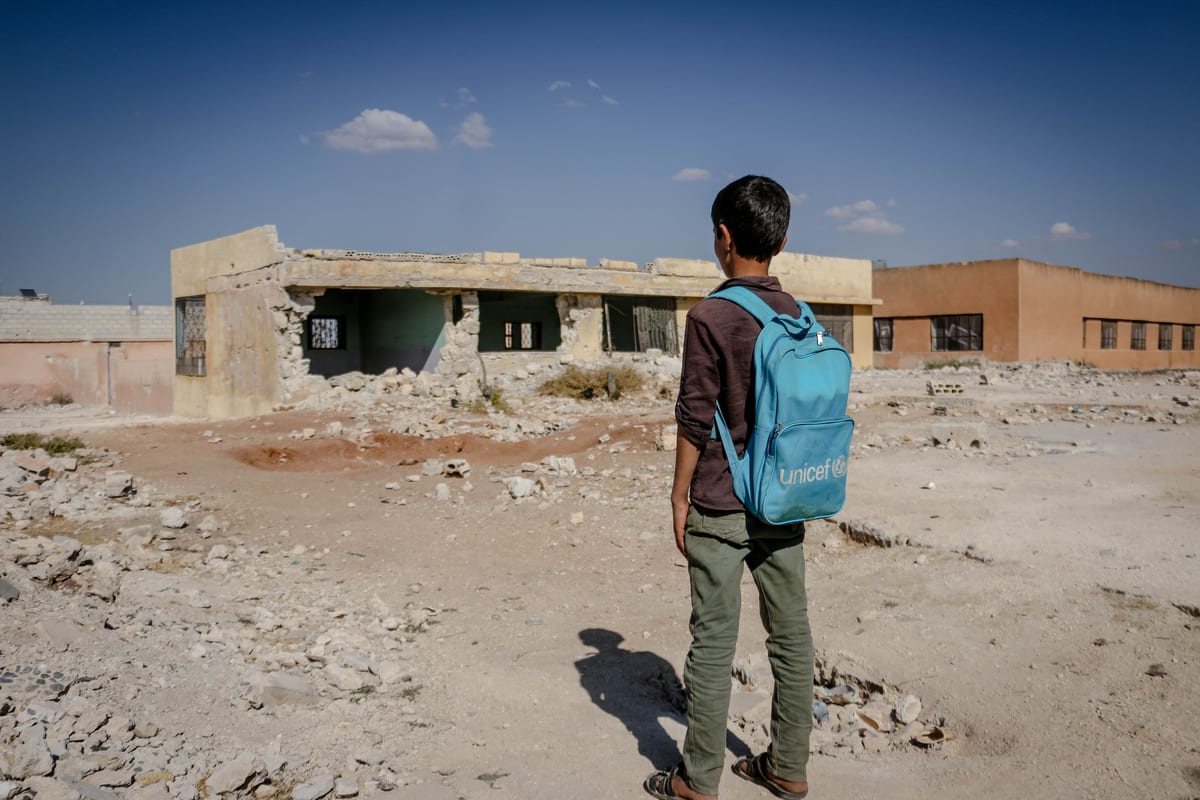
Three hundred and thirty children. That is the number UNICEF documented as killed or injured in Sudan between January and June 2026 — roughly two children every day, in a war that entered its fourth year with no ceasefire in sight. The figure is a floor, not a ceiling. In a country where hospitals have been shelled, communication networks gutted, and aid convoys blocked at checkpoints, the children who die without a UN agency present go uncounted.
The conflict that erupted in April 2023 between the Sudanese Armed Forces and the Rapid Support Forces has since produced one of the world's most severe humanitarian catastrophes, displacing millions, collapsing food systems across the Sahel's eastern edge, and now industrialising civilian killing through drone warfare. Aerial strikes on residential areas — reported repeatedly in 2025 and accelerating through the first half of 2026 — represent a shift in how the war is being fought. They kill at scale and at distance, leaving no fingerprints at the scene, and they are reaching urban civilian populations that ground offensives had not.
What the Numbers Actually Measure
Child mortality and injury figures in conflict zones reveal the condition of the whole civilian system underneath. When 330 children are counted as casualties in six months, it tells us that schools and hospitals are being struck or emptied, that families cannot reach safe shelter fast enough, that the early-warning architecture that saves lives in functioning states has collapsed.
Sudan's collapse unfolded in stages that the international community registered but did not arrest. The 2023 outbreak ended a fragile transitional government that had itself followed decades of authoritarian rule. What followed was not a coup with a political horizon but a war between two armed factions, each with external patrons, each willing to use civilian areas as operational terrain. By mid-2026, the pattern UNICEF documents — drone strikes, children among the dead — is no longer an emergency phase. It is the settled shape of the conflict.
Port Sudan, the Red Sea, and the Geometry of Indian Trade
India's commercial exposure to Sudan's instability is structural. Port Sudan sits on the western shore of the Red Sea — the same corridor through which a substantial share of Indian goods move toward East African markets and onward to the Gulf. When the port functions, it serves as a logistics node connecting Indian pharmaceutical and consumer-goods exports to a continent India has staked significant diplomatic capital on reaching. When the port is caught inside a war economy, subject to blockades, infrastructure damage, and the administrative chaos of a state in collapse, those supply chains do not merely slow — they redirect through more expensive routes or stop altogether.
Sudan's war has already disrupted regional trade patterns, and the acceleration of violence through 2026 compounds what was already a difficult operating environment. India's ambitions in African trade — deepened through G20 engagement with the African Union — require functional logistics corridors. The Red Sea is the most direct of those corridors for East Africa. A sustained Sudanese civil war is a structural tax on that ambition.
Operation Kaveri Was a Capability, Not a Conclusion
In 2023, India organised the evacuation of thousands of its citizens from Sudan in what became known as Operation Kaveri — a demonstration of real logistical reach in a deteriorating security environment. The operation drew on Indian Navy and Air Force assets and the MEA's crisis coordination infrastructure. And then, largely, the Sudan file closed in Indian diplomatic attention.
Analysts working on India's Africa engagement have argued since — and the Sudan escalation makes it harder to dismiss — that Operation Kaveri revealed a capability India has not converted into sustained diplomatic engagement. Evacuation capacity is reactive by definition. What it proved is that India can project logistical and consular reach in sub-Saharan Africa when the pressure is acute enough. The question that follows is whether India builds on that capacity to prevent the next acute crisis, or waits for the next evacuation trigger.
With an Indian diaspora still present in Sudan — a community that required emergency extraction once and remains in a country where the fighting has intensified — the case for a proactive monitoring architecture, rather than a reactive consular scramble, is clear. Analysts associated with Carnegie India have flagged precisely this gap: India's diaspora protection framework is reactive, and high-risk African states warrant something more systematic.
The 'Vishwabandhu' Claim Needs a Sudan-Shaped Answer
India's framing of itself as Vishwabandhu — a friend of the world, a voice for the Global South, a power that shows up without extractive conditions — requires geographic content to be credible. In Asia, the framing lands relatively easily; India's neighbourhood engagement, its disaster-response record in the Indian Ocean, its development financing in South and Southeast Asia all provide substantive ballast. In Africa, the record is thinner and the competition sharper.
China and Gulf actors — Saudi Arabia and the UAE in particular — are more visibly embedded in Sudan's political economy. They have financial relationships with both parties to the conflict, infrastructure investments, and active diplomatic channels. Whether those relationships translate into leverage for humanitarian outcomes is another question, but they represent presence. India has proximity via diaspora, trade corridor interests, and African Union diplomatic standing, but it has not converted these into a visible Sudan-specific posture during the 2026 escalation.
India's consistent UNSC position — support for ceasefire, humanitarian access, and an African Union-led political process — is the right doctrinal baseline. The gap is between the doctrine and the activation. Egypt and Saudi Arabia, both of which India maintains substantive bilateral relationships with, are key external actors in the Sudan conflict. Pushing through those bilateral channels for protected humanitarian corridors — specifically for children and civilian infrastructure, the precise category UNICEF is now documenting casualties in — is the kind of concrete action that distinguishes an active Vishwabandhu from a declaratory one.
The Drone Question India Cannot Ignore
Sudan's accelerating drone campaign lands in a specific context for India. IWE has recently covered the drone warfare lessons emerging from Ukraine and the broader UN debate over lethal autonomous weapons governance. Sudan adds a different dimension: drone strikes used not on military frontlines but against urban civilian populations, with children constituting a documented fraction of the casualties. This is drone warfare as a humanitarian catastrophe instrument, not as a precision military capability.
India, which is building its own drone manufacturing base and navigating the international governance debates around autonomous weapons, has an interest in how the international community documents and responds to drone use against civilians. The normative architecture being built now — what constitutes a violation, what accountability mechanisms apply, what protection obligations follow — will eventually govern the operational environment that India's own systems inhabit. Silence on Sudan's drone campaign is not neutrality; it is an abstention from the norm-setting conversation at precisely the moment when the norms are being written.
The 330 children UNICEF counted in the first half of 2026 are not a statistic that belongs only to Sudan's tragedy. They are a signal about what this war has become and where it is going. For India, the question is whether its Africa engagement deepens fast enough to matter — not after the next evacuation crisis, but before it.