There is a moment, usually just after sunrise, when the Shore Temple at Mahabalipuram looks less like a monument and more like a prayer that never quite ended. The Bay of Bengal stretches behind it, grey-green and enormous. The salt wind moves through the carved gopuras. A fisherman draws his boat past the ancient breakwater. And the granite, that immovable, patient, Pallava granite, glows amber in the early light as if it has been holding the sun in trust since the 7th century CE.
This is Mahabalipuram. And it is very much alive.
A City Carved by Kings Who Thought in Stone
Situated about 60 kilometres south of Chennai on Tamil Nadu's Coromandel Coast, Mahabalipuram, also known as Mamallapuram, was the port city of the Pallava dynasty, who ruled much of South India between the 4th and 9th centuries CE. Under kings like Narasimhavarman I (who earned the epithet Mamalla, meaning "great wrestler") and his successors, this coastal settlement became one of the most accomplished artistic centres the ancient world had ever seen.
The Pallavas used architecture as theology and sculpture as political statement. Working with a confidence that still astonishes contemporary visitors, their craftsmen carved entire temples and narrative panels from single boulders, no mortar, no assembly, no margin for error. The result is a landscape shaped by intention at every turn.
In 1984, UNESCO recognised what generations of pilgrims, scholars, and seafarers had always known: Mahabalipuram's Group of Monuments was a World Heritage Site of outstanding universal value. Today, the destination is listed among India's most significant cultural landmarks by the Ministry of Tourism's Incredible India portal.
The Monuments: More Than a Museum
What strikes every visitor first is the sheer scale of creative ambition compressed into a few square kilometres. The Pancha Rathas, five monolithic chariot-shaped temples, each carved from a single long granite ridge, are dedicated to the Pandava brothers and Draupadi of the Mahabharata. No two rathas are identical; each experiments with a different architectural style, as though the Pallava craftsmen were deliberately prototyping every form the Indian temple tradition might take.
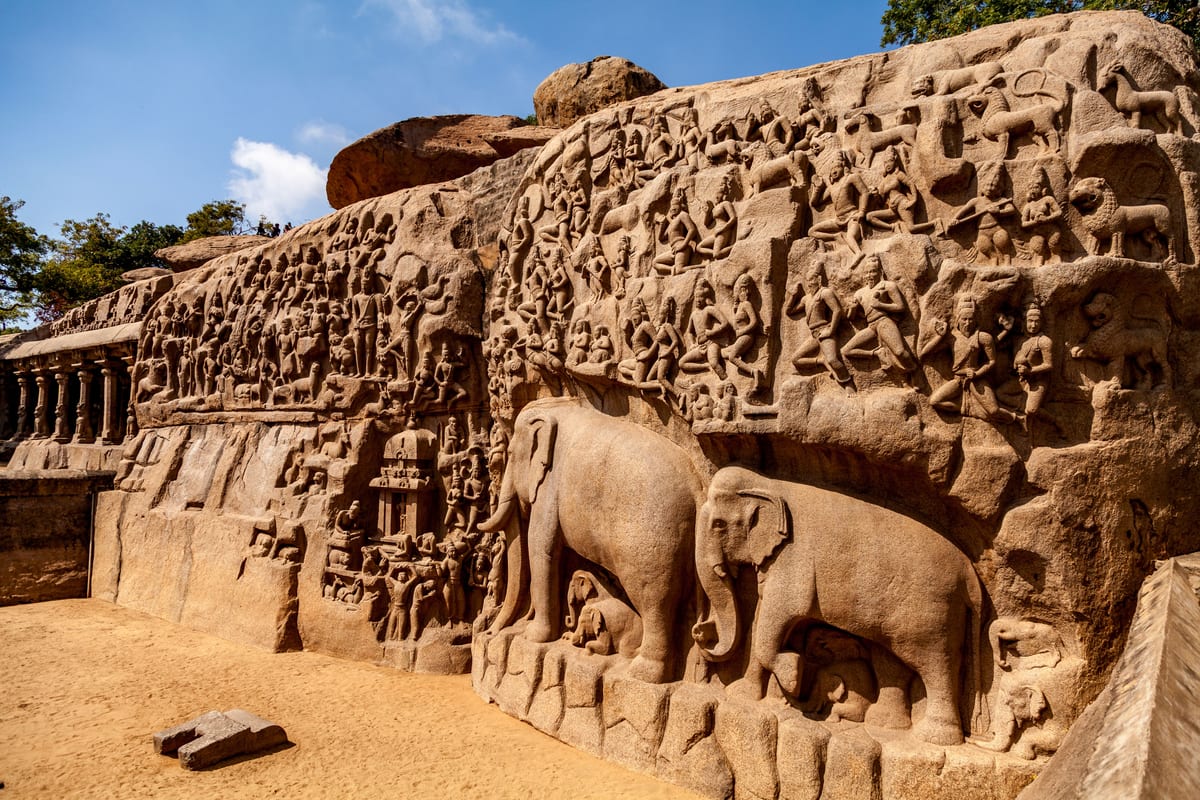
The Arjuna's Penance, or Descent of the Ganges, is perhaps the most breathtaking open-air bas-relief in the world. Carved across the face of two enormous boulders, this panel stretches nearly 30 metres wide and 15 metres high, teeming with gods, celestial beings, animals, and humans, all converging on a natural cleft through which water once flowed to simulate the sacred river descending from heaven. Every figure carries movement, emotion, and narrative purpose. To stand before it is to see that ancient India did not separate art from scripture, or beauty from meaning.
The Shore Temple, rising in tiered gopuras directly above the beach, is the oldest structural (as opposed to rock-cut) temple in South India still standing. Dedicated to both Shiva and Vishnu, an act of deliberate theological inclusivity, it has watched the Bay of Bengal rise and fall for over thirteen centuries. Legend holds that several older temples once stood here before the sea claimed them; occasionally, after major storms or tsunamis, their submerged outlines appear briefly beneath the waves, lending Mahabalipuram an almost mythic quality.
Beyond these celebrated sites, the town is scattered with smaller cave temples, sculpted mandapas, and the famous Krishna's Butter Ball, a natural granite boulder the size of a house balanced impossibly on a smooth slope.
A Civilisational Crossroads, Not a Closed Chapter
Mahabalipuram was never an inward-looking place. As a thriving Pallava port, it sent merchant ships, and with them, Indian art, religion, and political ideas, across the Bay of Bengal to Burma, Thailand, Cambodia, and the Indonesian archipelago. The Hindu and Buddhist temple traditions of Southeast Asia owe a measurable debt to what was refined here on this granite coast. When you look at Angkor Wat, trace that line back to Mahabalipuram.
This outward-facing character persists. The town today is home to a living tradition of stone sculpture, with workshops lining the road to the monuments, where craftsmen trained across generations still cut granite with the same chisels and mallet rhythms their forebears used. You can watch a sculptor render a dancing Nataraja with the same fluency a calligrapher might bring to verse. This is what civilisational continuity looks like, not preserved behind glass, but warm with labour and breath.
Practical Guide: When to Go and How to Get There
The best time to visit Mahabalipuram is between October and March, when Tamil Nadu's coastal climate is pleasantly cool and dry. The monsoon months from June to September bring heavy rainfall along the Coromandel Coast, though the landscape becomes dramatically green and the monuments take on a different, equally compelling character.
Mahabalipuram is easily reached from Chennai, approximately 60 kilometres to the north, via the East Coast Road (ECR), one of India's most scenic coastal highways. Regular bus services and taxis operate from Chennai city and Chennai airport. The nearest major railway station is Chengalpattu, about 29 kilometres inland, with onward road connections to the town. The closest international airport is Chennai International Airport.
Nearby attractions worth combining into your visit include Kanchipuram, the ancient city of silk and temples about 70 kilometres away, and the Crocodile Bank, a wildlife conservation centre on the ECR. The town itself offers a range of accommodation from budget guesthouses to boutique heritage properties, and Tamil coastal cuisine, fresh seafood, rice dishes fragrant with tamarind and coconut, is reason enough to linger.
Why Mahabalipuram Matters
India has many ancient sites. Mahabalipuram is something rarer: an ancient site that never quite became ancient in the distancing sense of the word. The stone is old. The ideas it carries, about divine order, human ambition, artistic excellence, and the relationship between a civilisation and its sea, are not. They are still being worked out, still being chiselled, in the workshops along the dusty road that leads to the Shore Temple.
Come here not to see what India was. Come here to understand what India has never stopped being.