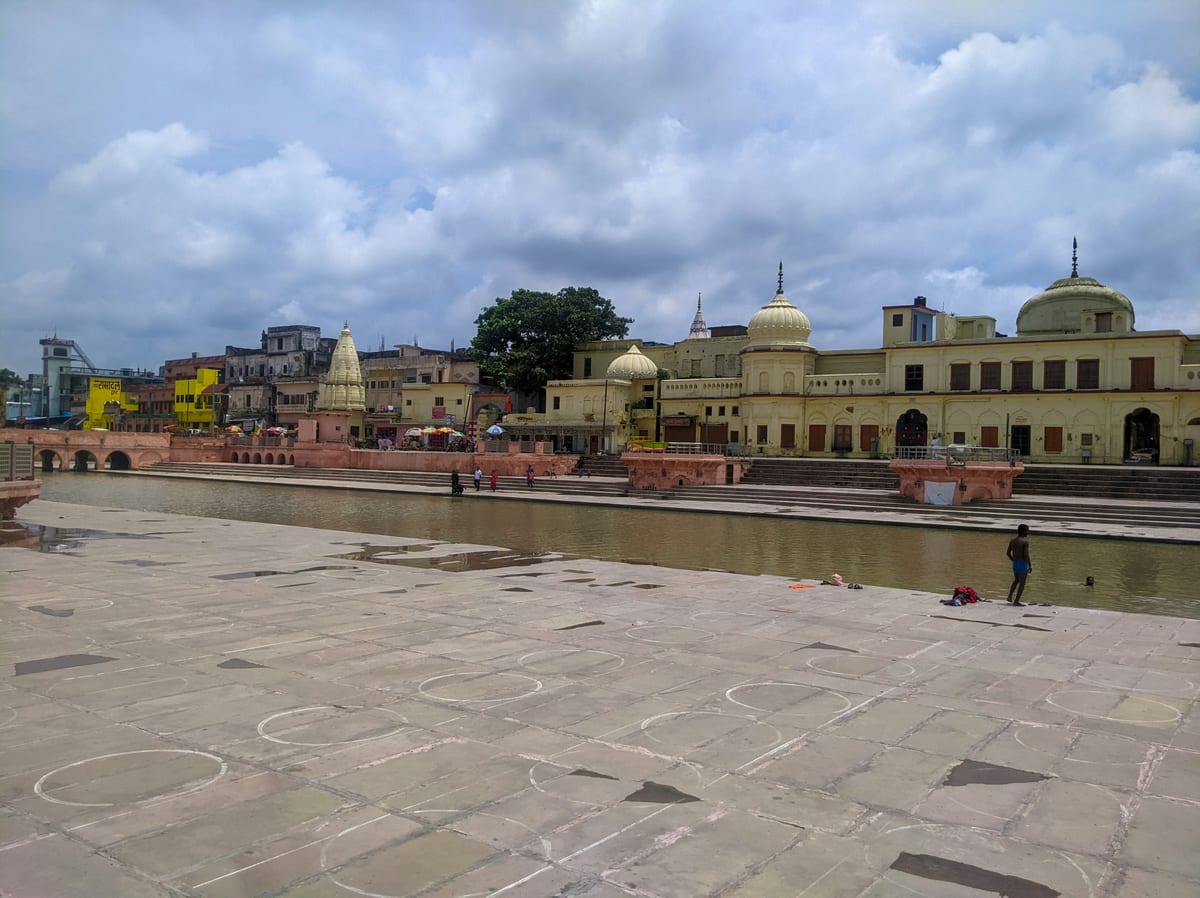
Money given to god is, in most Indian traditions, a matter of absolute trust. Which is why the allegation that donations made to the Shri Ram Janmabhoomi Teerth Kshetra Trust at Ayodhya were embezzled carries a weight that goes far beyond normal institutional embarrassment. This is not a management controversy alone. It touches the symbolic centre of what the Ram Mandir was built to represent.
The trust convened an emergency meeting on July 6. Temple administration assistant Gopal Rao confirmed to ANI it would take place at 3 pm inside the temple complex, with Mahant Nritya Gopal Das presiding and all members notified. That a meeting had to be called under the pressure of an escalating political confrontation says something about how quickly the situation deteriorated.
The Political Geometry
The Opposition's response was swift. Samajwadi Party MP Awadhesh Prasad, who represents Faizabad, the Lok Sabha constituency that encompasses Ayodhya, went further than most: he demanded the trust be dissolved and an investigation conducted with all trust members removed from the process. That is a maximalist position, designed less to solve the problem than to define it — the trust as a BJP-adjacent body, the BJP as the accused manager of a Hindu institution.
In Mumbai, Shiv Sena (UBT) chief Uddhav Thackeray led a RamRaksha protest at Dadar Hanuman Temple, declaring that Hindus would not forgive those who stole from Rama's name. His party's MP Arvind Sawant questioned the fate of donations made by Shiv Sena (UBT) itself. The BJP accused the Opposition of politicising the faith of millions.
The RSS broke its silence, calling the alleged conduct highly condemnable. That is notable. The RSS does not typically wade into institutional controversies involving bodies close to its ideological universe unless it calculates that staying silent costs more than speaking.
From Congress, Karnataka Minister Priyank Kharge questioned the moral standing of the RSS to call for punishment, framing it as the RSS belatedly acknowledging a failure it shares responsibility for. Every political formation has found its preferred angle, and none of them are primarily interested in the governance answer.
What the Political Noise Obscures
Strip the rhetoric and you are left with a structural question that Indian public life has avoided answering for a very long time: who governs the governors of major religious endowments?
The Shri Ram Janmabhoomi Teerth Kshetra Trust is not an ordinary charitable body. It was constituted under a Supreme Court order — born from one of the most consequential legal proceedings in Indian history — and manages donations that run into hundreds of crores. Its public accountability, however, rests on no unified regulatory architecture. There is no central statute mandating independent audit, public disclosure of accounts, or external oversight for trusts of this national significance.
India's existing religious endowments framework is a patchwork. State governments operate their own endowments boards — primarily covering Hindu temples in the south — while trusts constituted by court order or by central notification occupy a grey zone. The assumption, until now, has been that the symbolic weight of an institution like the Ram Mandir trust would itself enforce discipline. The present controversy suggests that assumption was optimistic.
India has had this conversation before, with every major religious institution that has faced a financial scandal. The answer has consistently been to resolve the immediate political problem — usually through an internal inquiry or a government-appointed committee — and defer the structural question. The Ram Mandir episode is that future arriving anyway.
The Civilisational Stakes
The consecration of the Ram Mandir in January 2024 was presented, with considerable deliberateness, as a statement of civilisational continuity — India recovering something that had been interrupted. The event drew global attention, positioned Ayodhya as a heritage centrepiece, and was received by a significant section of the Indian public as a moment of collective meaning.
That framing creates a particular kind of vulnerability. An institution carrying civilisational weight cannot afford governance failures that ordinary institutions might survive through procedural correction. The reputational stakes are not proportionate to the size of the alleged irregularity — they are proportionate to the symbolic weight attached to the institution itself. An allegation of donation misappropriation at the Ram Mandir trust does not produce a management crisis. It produces a narrative crisis, one that Opposition parties — from the SP to Shiv Sena (UBT) to Congress — are now shaping in real time.
The trust's general secretary Champat Rai, as the public face of the institution, faces a burden of clarity at the July 6 meeting that goes beyond internal administrative resolution. The trust must demonstrate, to a public that donated in faith, that its processes are sound. An internal meeting, however well-conducted, will not by itself close the reputational gap if the findings remain opaque.
The Regulatory Architecture India Needs
There is a longer-term reform question sitting underneath this week's political exchange. India's government — whether at the central level or through the Uttar Pradesh administration, which functions as the primary oversight authority for the trust — will eventually have to confront the absence of a mandatory independent audit mechanism for institutions of this scale.
The argument against such a framework has historically been that religious autonomy must be protected from state encroachment. That argument has some constitutional weight. But it confuses two distinct things: the state directing how religious worship is conducted, which is genuinely problematic, and the state requiring transparent financial disclosure from institutions managing public donations at national scale, which is straightforwardly a matter of public accountability. A temple's theology is its own. Its accounts, when funded by voluntary public donation, are another matter.
Several southern states have operated temple endowment boards for decades, with varying records of success and their own documented shortcomings. The point is not that centralised state management produces better outcomes — the record is mixed at best — but that some form of enforceable accountability framework exists. For trusts constituted by Supreme Court order, the case for independent audit with mandatory public disclosure is, if anything, stronger than for state-administered endowments. The court's authority created the institution; some form of ongoing accountability to that authority — or to a statutory replacement — is not an unreasonable expectation.
What the Ayodhya episode demonstrates, with uncomfortable clarity, is that India built a landmark institution of civilisational significance and left its financial governance to the honour system. The political storm of this week will pass. The structural gap will remain, and the next controversy will find it exactly where this one did: open, unaddressed, and perfectly positioned to produce maximum damage to the institution it was supposed to protect.