There are cities that preserve the past, and there are cities that are the past, still alive, still breathing, still performing the same rituals that shaped a civilisation. Rishikesh, perched at the edge of the Himalayas where the sacred Ganga sweeps down from the mountains into the plains, belongs firmly to the second category. To arrive here is not to step into a museum of India's spiritual heritage. It is to step into the heritage itself.
A Name Rooted in Eternity
The word Rishikesh carries its meaning in plain sight. Derived from the Sanskrit words Rishi, sage, and Kesh, hair, the name conjures the countless enlightened souls who retreated to these riverbanks over millennia, their matted locks a mark of their renunciation and their wisdom. Long before yoga studios appeared in London and New York, long before wellness tourism became a global industry, sages sat here beside the Ganga and mapped the inner landscape of the human soul. That lineage is unbroken. You can feel it in the air, in the chanting that rises from the ghats at dusk, in the bells that ring across the water at sunrise.
Hindu mythology runs deep through Rishikesh. At the serene Triveni Ghat, it is believed that Lord Rama performed penance after slaying Ravana, a king yet a Brahmin, whose death required atonement even from a divine king. That moral seriousness, that insistence on accountability even in victory, is part of what Rishikesh teaches simply by existing. This is a place where stories are not decorative. They are instructions.
The Yoga Capital of the World
Rishikesh earned its designation as the Yoga Capital of the World through centuries of practice, not branding. The ashrams that line the banks of the Ganga are institutions of learning, some centuries old, where the eight limbs of yoga articulated by Patanjali are taught as a complete philosophy of living, not merely a sequence of postures.
The West discovered Rishikesh dramatically in the 1960s when the Beatles made their now-legendary visit to study under Maharishi Mahesh Yogi, placing this small Himalayan town on the global cultural map almost overnight. But Rishikesh did not change to accommodate that attention. The pilgrims kept coming. The gurus kept teaching. The Ganga kept flowing. What the world found when it arrived was not a destination that had prepared itself for visitors, it was a civilisation that had simply continued to be itself.
Today, serious practitioners of yoga and meditation travel from across the world to study under renowned gurus, to practise asanas in ashrams by the riverside, and to immerse themselves in teachings refined over generations. Whether you are a seasoned yogi or someone who has never unrolled a mat, Rishikesh recalibrates your inner compass.
The Gateway to Char Dham
For devout Hindus, Rishikesh occupies a strategic sacred geography. It is the traditional starting point of the Char Dham Yatra, the pilgrimage to the four holiest shrines of the Himalayas: Yamunotri, Gangotri, Kedarnath, and Badrinath. Pilgrims have set out from Rishikesh's ghats for centuries, seeking purification and the blessings of the divine at altitudes where the air itself feels consecrated.
Even for the traveller who does not undertake the full pilgrimage, standing at the Rishikesh riverfront as pilgrims prepare for their journey north is humbling. India's civilisational continuity is not an abstraction in that moment. It is a grandfather in saffron, a young woman with a small lamp, a family from Tamil Nadu speaking to a family from Bengal in the common language of devotion.
The Living Landmarks
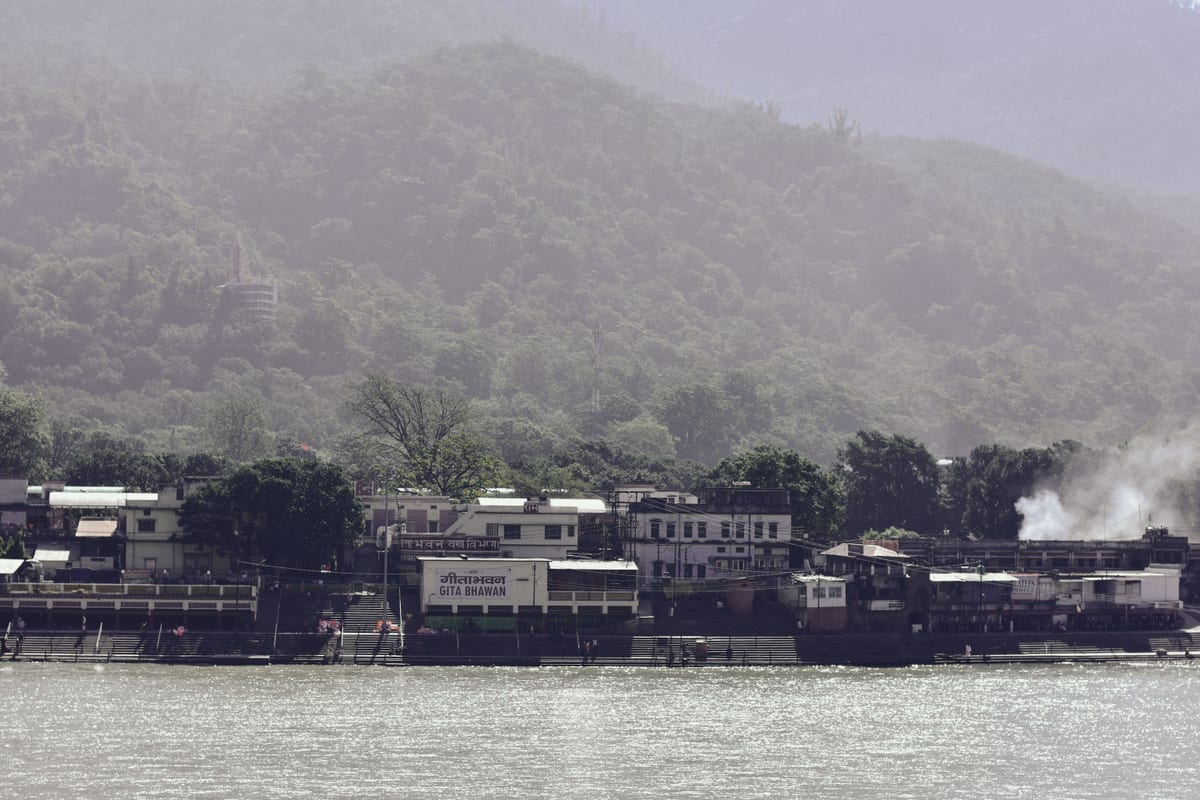
Two landmarks define the visual identity of Rishikesh and they are, fittingly, bridges, connections, not destinations. Ram Jhula and Laxman Jhula, the iconic suspension bridges that sway gently above the Ganga, link the two banks of the river and the two worlds that Rishikesh holds in balance: the ancient and the contemporary, the pilgrim and the curious traveller. Walking across these bridges, the river roaring below, temples rising on both banks, sadhus moving with unhurried purpose, is one of those rare travel experiences that requires no explanation. It simply lands.
The colourful ashrams that crowd the riverbanks, the chai stalls wedged between temples, the evening aarti ceremonies at Triveni Ghat where lamps are floated on the dark water, these are not performances staged for visitors. They are the rhythm of daily life here, and you are welcome to sit quietly within that rhythm and let it do its work.
Best Time to Visit
Rishikesh is a year-round destination, though the experience shifts dramatically with the seasons. According to Incredible India's official Rishikesh page, temperatures range from cool winter mornings, around 5°C in December and January, to warm summer afternoons that can reach above 40°C in May and June. The monsoon months of July and August bring the Ganga to full, powerful flood, which is dramatic to witness but may limit some outdoor activities.
The ideal windows for most visitors are October to November and February to April. In these months, the weather is temperate, the skies are clear, and the Himalayas are visible in their full grandeur on the horizon. The post-monsoon autumn season is particularly beautiful, the hills are lush, the air is sharp, and the light on the river in the early morning is extraordinary.
How to Reach Rishikesh
Rishikesh is well connected and genuinely accessible. The nearest airport is Jolly Grant Airport (DED) in Dehradun, approximately 35 kilometres away, with regular flights from Delhi and other major Indian cities. For those travelling from abroad or from cities farther afield, Indira Gandhi International Airport (DEL) in Delhi is the major international hub, from which Rishikesh is roughly a five to six hour drive through the Himalayan foothills, a journey that is itself part of the experience. Travellers preferring rail can arrive at Rishikesh Railway Station (RKSH), which connects to the national rail network. From the station, the town's key areas are easily reachable by local transport.
Why Rishikesh Matters
India has no shortage of ancient places. What Rishikesh offers that is rarer is an ancient place that has not been preserved, it has been continued. The yoga being practised on these riverbanks today is in direct philosophical lineage with the sages whose presence named this city. The pilgrims departing for Char Dham are walking routes that have been walked for a thousand years. The evening aarti is not a recreation. It is tonight's edition of a ceremony that has been performed every evening, without interruption, across generations.
That is what civilisational continuity actually looks like. Not a monument. Not a heritage site cordoned off with rope. A city, still alive, still doing what it has always done, offering a place where the noise of ordinary life quiets just enough for something older and quieter to be heard.
Come to Rishikesh for a morning yoga class if you like. Come for the adventure sports on the Ganga, for the trekking routes that open into the Himalayas, for the food at the riverside cafés. But allow time, also, to simply sit at the edge of the river as the sun goes down and the lamps come out. That requires nothing from you except your presence. And it will give you more than you came expecting.