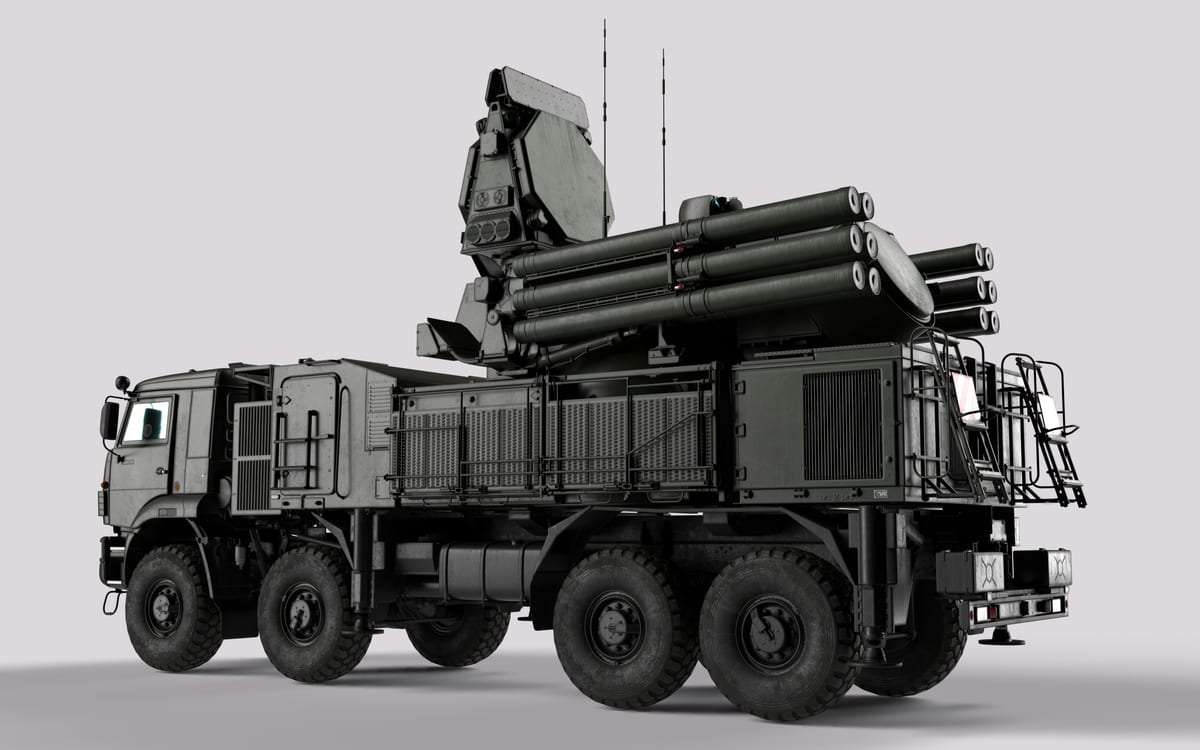
The US Army awarded Lockheed Martin a contract worth up to $58.6 billion to manufacture Patriot interceptor missiles, converting a previous one-year, $4.7 billion deal signed in April into a seven-year procurement plan stretching from fiscal year 2026 through 2032. The announcement comes roughly five months into the US-Iran conflict, as Washington simultaneously supplies munitions to allies and uses them in its own strikes against Tehran — a dual drain that Pentagon officials acknowledge has left critical stockpiles under strain.
The contract figures are significant. Lockheed, headquartered in Bethesda, Maryland, will triple production capacity for PAC-3 MSE interceptor missiles by the end of 2030. Its Camden, Arkansas facility will expand its workforce by 50 per cent — from roughly 1,200 to around 1,850 employees. This is industrial mobilisation on a scale the United States has not attempted since the Cold War's final decades, with consequences that extend well beyond the Potomac.
When the Arsenal Turns Inward
The Pentagon's urgency is rooted in structural necessity. Simultaneous conflicts — one in Ukraine, one involving direct US military operations in Iran — compress what defence economists call the "regeneration window," the period between when a stockpile depletes and when replenishment production catches up. The Trump administration has compounded this by pressing contractors to prioritise output over shareholder returns, with an executive order signed in January directing officials to identify companies failing on government contracts while continuing to distribute profits. Industry executives welcome the long-term purchase commitments but note that Congress must appropriate funding before manufacturers can invest in components and production capacity — a legislative dependency that adds further uncertainty to delivery timelines.
This dynamic is flagged as consequential by analysts tracking Indian defence acquisitions. Laxman Kumar Behera at IDSA has argued that US stockpile depletion in prolonged conflicts historically delays Foreign Military Sales to partner nations. When a defence industrial base redirects capacity toward domestic replenishment on a seven-year contract, partner-nation orders queue behind sovereign priority. India's Ministry of Defence, deepening defence and technology ties with Washington under the Major Defence Partner framework, should treat the Lockheed contract as a signal about the availability of US-origin systems over the next decade.
The Hormuz Variable
The military dimension is secondary to the energy dimension. The US-Iran conflict is the same conflict that menaces the Strait of Hormuz, the narrow chokepoint through which a substantial share of India's crude oil imports transit. India imports over 85 per cent of its oil needs, with the Gulf region supplying the overwhelming portion. Any disruption to Hormuz transit spikes Brent crude prices and widens India's current account deficit, pressuring the rupee in ways that translate directly into household fuel costs and freight inflation across the supply chain.
Shyam Saran, former Foreign Secretary, has written that India's energy import diversification remains incomplete, making Gulf stability a tier-one national security interest. India has made incremental progress in diversifying oil sourcing — drawing from Russia, the United States, and Latin America — but the Gulf's geographic and pricing advantages mean that diversification has a ceiling. No diplomatic formula substitutes for physical proximity and pipeline infrastructure.
The nine million members of the Indian diaspora spread across Gulf states add a consular dimension. A broadening conflict involving direct US strikes in Iran and potential Iranian retaliation puts Indian workers in Qatar, the UAE, Kuwait, and Saudi Arabia in proximity to a conflict zone — close enough that evacuation planning and consular preparedness are legitimate policy concerns.
Chabahar in the Crosshairs
India's Chabahar port investment complicates the picture in a specifically Indian way. The port on Iran's southeastern coast gives India a strategic land corridor bypassing Pakistan and reaching Afghanistan and Central Asia — an access route with commercial and geopolitical dimensions that no other geography replicates. Washington maintains a sanctions carve-out for Chabahar, recognising its regional stabilisation utility. But the architecture of sanctions carve-outs is not permanent. It reflects political judgements that shift as conflicts evolve, and a deepening US-Iran confrontation creates conditions under which Washington might revisit the accommodations it has extended.
Harsh V. Pant at the Observer Research Foundation has argued that India's Gulf policy must remain insulated from US-Iran binary choices, and that the Chabahar investment is too strategically significant to subordinate to Washington's Iran posture. India's leverage here is real. Chabahar represents one of the few infrastructure investments in the region that serves connectivity interests across multiple parties, including Central Asian nations seeking sea access. New Delhi's interest lies in signalling, through quiet diplomatic channels to both Washington and Tehran, that the port's operational neutrality serves broader regional stabilisation and that its disruption would harm parties well beyond the bilateral US-Iran confrontation.
What the Contract Actually Signals
The contract tells a straightforward story. The United States is reconstituting its own air defence arsenal for at least the next seven years. Lockheed's production capacity goes there. Congressional appropriations, when they come, get allocated there. The global arms market has operated for decades on the assumption of American surplus — Washington's ability to sell advanced systems to partners while maintaining its own stockpiles. The Patriot contract marks a departure from that assumption, at least for this category of interceptor missile and at least through the early 2030s.
India's defence planners should treat this as a planning variable. It argues for accelerating indigenisation timelines, deepening co-development arrangements with partners less constrained by active-conflict replenishment demands, and stress-testing acquisition schedules against the realistic possibility of US delivery delays. The Defence Research and Development Organisation and the private sector companies increasingly integrated into India's defence industrial ecosystem provide a structural answer to this dependency; the Lockheed contract is a useful reminder of why that answer matters.
On the energy side, the case for pre-negotiating supply guarantees with Gulf producers — agreements that activate automatically if Hormuz transit degrades — has been made by analysts for years and deferred by policymakers for years. The active US military presence in the Gulf, the scale of the munitions being committed to sustaining it, and the five-month duration of a conflict showing no sign of rapid resolution are collectively the strongest argument yet that deferral carries a cost. India does not need to take a position on the US-Iran confrontation to act on its own energy security interests. Those two things are entirely separable, and keeping them separate is precisely the strategic autonomy that India's foreign policy posture has historically prized.