In the arithmetic of port economics, a 256% jump in EBITDA from a single business segment is not a quarterly fluctuation — it is a structural announcement. When Adani Ports and Special Economic Zone (APSEZ) reported its Q1 results, the headline numbers — a 10% year-on-year rise in net profit and a 19% increase in overall EBITDA — told one story. The international ports segment told another. Revenue from overseas operations surged 80% year-on-year to Rs 1,747 crore. EBITDA from the same segment leapt 256% to Rs 730 crore. These are the numbers of an operator that has figured out the model.
Karan Adani, CEO of APSEZ, described the quarter's performance as driven by volume growth at domestic ports and what he called a 'transformational scale-up' of the international portfolio, signalling that overseas acquisitions remain a strategic priority. The international portfolio currently spans the port of Haifa in Israel, the Colombo West terminal in Sri Lanka, Dar es Salaam in Tanzania, and Vizhinjam on India's southwestern tip — assets that map across the Indian Ocean's most contested commercial geography.
Private Capital at the Chokepoints
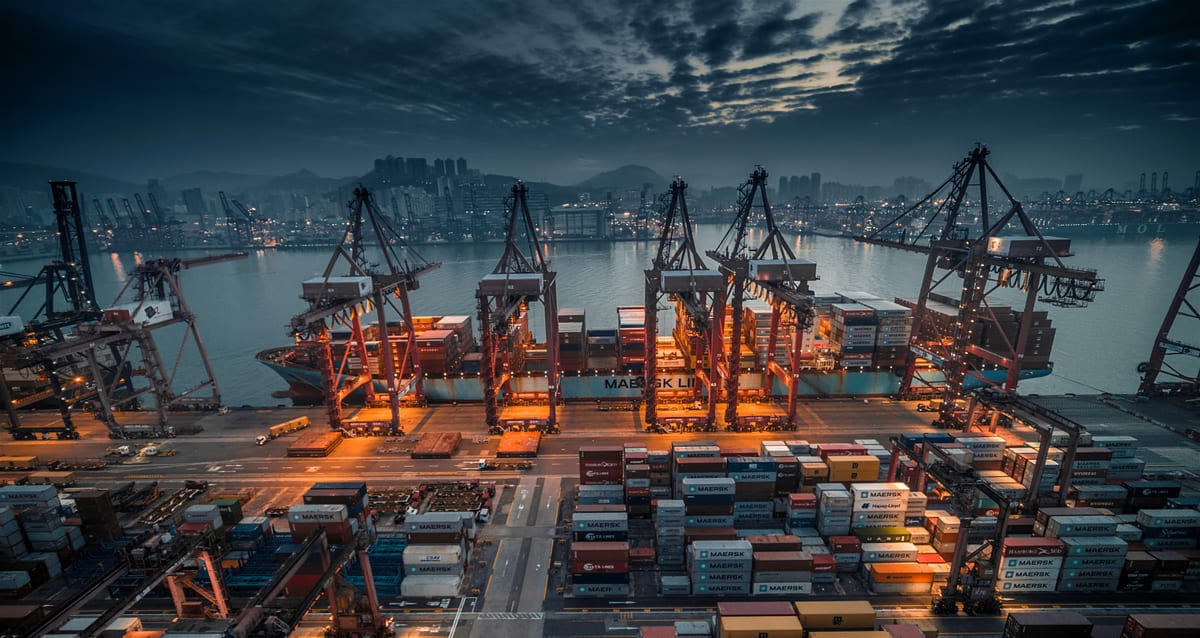
Port strategy is geography made bankable. The locations APSEZ operates are not incidental choices. Haifa sits at the eastern Mediterranean's commercial gateway. Colombo handles transhipment traffic that would otherwise bypass South Asia entirely. Dar es Salaam anchors East Africa's Indian Ocean coast. Vizhinjam, once operational at scale, could redirect transhipment cargo currently routed through Colombo and Singapore back through Indian waters.
China understood this geometry early. Its Belt and Road port investments — Hambantota, Gwadar, Chittagong — were strategic infrastructure dressed in commercial clothing. Whether those investments constituted debt traps has obscured the simpler point: they placed Chinese operators at nodes that matter for Indian Ocean logistics and, when tensions arise, for naval contingency planning. APSEZ's international expansion is India's private-sector answer to that geography — without the debt-trap accusation, without state guarantees, and generating a 256% EBITDA return to prove the commercial case.
Analysts at the Observer Research Foundation have noted that APSEZ's Haifa investment — made alongside Israeli and UAE partners — exemplifies what the I2U2 grouping can achieve when diplomatic frameworks translate into hard infrastructure outcomes. The Quad's 2024 summit fact sheet identified high-standard physical infrastructure in the Indo-Pacific as a priority, but the actual work at Haifa was done by private capital following commercial logic that happened to align with strategic objectives. India benefits from the alignment without having guaranteed a rupee of the risk.
The Architecture That Is Missing
This is where the Q1 results reveal a tension. The Ministry of Ports, Shipping and Waterways has identified private-sector overseas port development as a pillar of India's maritime export competitiveness, and the Sagarmala Programme and PM Gati Shakti framework both treat private port investment as central to the logistics transformation the government is pursuing domestically. The implicit state alignment with APSEZ's international trajectory is real. What is absent is institutional architecture to back it.
Japan's JBIC — the Japan Bank for International Cooperation — has spent decades co-financing port and infrastructure bids by Japanese private operators in Southeast Asia, Africa, and South Asia. China's policy banks provided the capital spine for Belt and Road port acquisitions that no purely commercial lender would have touched at the risk-adjusted returns available. Both mechanisms allowed their countries to pursue maritime strategic objectives through private operators without those operators absorbing the full political and financial risk of operating in sensitive geographies.
India has no equivalent instrument. APSEZ won Haifa, secured Colombo, and is building Vizhinjam on the strength of its own balance sheet and the commercial logic of each deal. That reflects the company's capital discipline. It is also a structural vulnerability. The next round of strategically significant port bids — in the Maldives, along the Red Sea corridor, in Bangladesh's deep-water aspirations — will arrive in geographies where political risk is higher and commercial returns are less legible. Without a sovereign co-financing mechanism analogous to JBIC, Indian operators bidding against state-backed Chinese or Japanese competitors carry an institutional handicap that private EBITDA alone cannot overcome.
The Domestic Reinforcement Loop
Strong APSEZ financials do something beyond advancing maritime strategy: they reinforce investor confidence in Indian infrastructure equity at a moment the sector needs long-term foreign capital. Infrastructure investment — ports, roads, power, logistics — requires patient capital with long return horizons. That capital flows most readily to operators with demonstrated profitability across cycles, and a 19% overall EBITDA increase and 10% profit growth in a single quarter, against a backdrop of global trade uncertainty, provides that demonstration.
The Hindenburg-triggered scrutiny of the Adani Group in 2023 created reputational friction for India's port-diplomacy narrative abroad — a situation where the commercial operator central to India's maritime ambitions was simultaneously defending its governance credentials internationally. SEBI's regulatory process ran its course. The Q1 results, sustained and improving, constitute the most durable counter-narrative available: the numbers hold, the operations expand, and the international partners — Israeli, Emirati, Tanzanian — remain engaged. For India's port-infrastructure export story, sustained quarterly performance matters more than any press release.
What the Numbers Ask of New Delhi
The Takshashila Institution has argued that India's maritime ambitions require sustained private-sector capital deployment abroad, and that a validated commercial model is a precondition for any broader maritime infrastructure export strategy. APSEZ's international EBITDA growth validates that model. The commercial case is now proven. What the results make visible by their success is the next question: can India formalise the institutional infrastructure to scale this model before the most strategically valuable ports in its neighbourhood are acquired by operators whose governments have already solved that problem?
India's maritime ambitions are running ahead of India's maritime financing architecture. APSEZ's Q1 results mark how far private capital has carried the country's port-power projection — and where the state needs to meet it halfway. The Rs 730 crore international EBITDA figure is not just a company milestone. It is the clearest argument yet for a government-backed maritime infrastructure export fund. Whether New Delhi treats it as such is the institutional question the next few quarters will begin to answer.