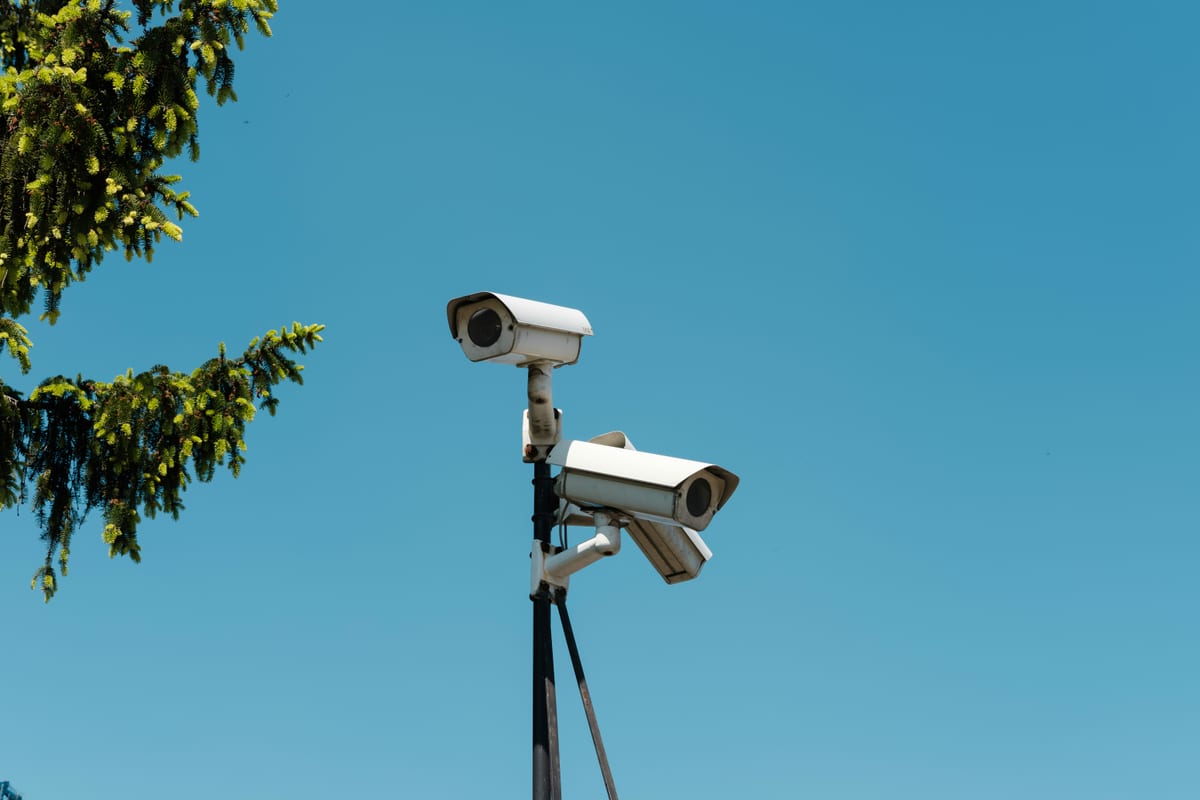
Jantar Mantar, the strip of road in central New Delhi that the Supreme Court and successive administrations have designated as India's sanctioned site for public protest, now has four Facial Recognition System units positioned at its entry and exit points. Delhi Police says the systems scan faces against its database of wanted criminals, absconders, and history-sheeters in real time. The stated logic is preventive: stop individuals with criminal antecedents from exploiting the cover of a legitimate demonstration. Officials have clarified that the technology is not directed at ordinary protesters exercising their democratic rights.
That clarification is the beginning of the story, not its end. What Delhi Police asserts, it cannot presently enforce in law—because no law yet exists to define the boundary it claims to be observing.
What the Deployment Actually Does
The technical architecture is straightforward. Four FRS units feed data in real time into the Delhi Police database, matching the faces of individuals entering or leaving the protest venue against records of persons with criminal antecedents. The system does not announce itself to those it scans. There is no opt-in, no visible notification at the perimeter, and no mechanism by which a person who is wrongly flagged can immediately contest the match. Police frame this as a law-enforcement tool, equivalent to deploying plain-clothes officers to watch a crowd. The analogy is superficially appealing and substantively incomplete.
A plain-clothes officer exercises individual judgment, is accountable through the command chain, and captures nothing that persists beyond the moment. A facial recognition system captures biometric data from every face that passes within its field of view, matches those faces against a database, and generates a log. The scale and permanence are categorically different. This is not an argument against the technology; it is an argument for the statutory clarity that should accompany it.
The Legal Vacuum at the Centre
India's Digital Personal Data Protection Act 2023 was passed by Parliament but has not yet operationalised its rules. Even when those rules come into force, the DPDPA is primarily a data-processing statute—it governs how personal data is collected and used by defined entities, but it does not constitute a surveillance reform law. It does not specify which biometric surveillance tools law enforcement agencies may deploy, under what judicial authorisation, at what accuracy thresholds, or with what redress mechanism for citizens who are wrongly identified.
The National Crime Records Bureau has been developing its Automated Facial Recognition System since at least 2019. The Parliamentary Standing Committee on Home Affairs flagged in its 2022 report the absence of regulatory guardrails for facial recognition in law enforcement, leaving the institutional momentum for deployment intact while the accountability architecture lagged behind. Internet Freedom Foundation founder Apar Gupta has argued that the AFRS rollout lacks parliamentary authorisation; legal researcher Usha Ramanathan has warned that without a surveillance reform statute, these deployments are governed only by executive discretion. Senior Advocate Vrinda Grover has argued before the Delhi High Court in related FRT cases that biometric surveillance at protest sites engages the right to privacy affirmed in the Supreme Court's Puttaswamy judgment of 2017.
None of these voices advocate that law enforcement abandon the technology. The argument is that the government's own stated rationale is stronger when it rests on a statutory foundation rather than on a press briefing.
Jantar Mantar as the Test Case
The choice of location matters more than the technology itself. Jantar Mantar is not an arbitrary public space. It is the site the state itself designated for protest; its very existence as a protest venue is an institutional acknowledgment that public assembly near Parliament is constitutionally legitimate. Deploying biometric capture there does not merely surveil a crowd—it surveils the act of assembly at the place specifically set aside for that act.
A citizen who knows that attending a protest at Jantar Mantar places their face in a law-enforcement database may calculate that the cost of participation has risen. That calculation happens in the mind before the Supreme Court or any high court has a chance to assess it. This is what makes the location of this deployment constitutionally distinct from, say, installing FRS at an airport or a railway terminus, where the surveillance rationale is immediate security rather than the monitoring of a rights-exercise.
Delhi Police has anticipated this objection by insisting the system targets criminals, not protesters. The insistence is credible as a statement of intent. It is not enforceable as a legal distinction because no statute draws that line.
The AI Governance Complication
India has invested considerable diplomatic capital in positioning itself as a responsible voice on AI governance through its G20 AI principles legacy, its participation in the Global Partnership on AI, and its engagement with multilateral AI safety discussions. The argument India advances in these forums is that the Global South can adopt advanced technology responsibly without importing every regulatory restriction that Western jurisdictions have developed in different contexts.
That argument is credible and worth defending. Credibility in multilateral AI governance conversations depends in part on being able to demonstrate, domestically, that advanced surveillance deployments operate within a defined legal perimeter. When a deployment as visible as facial recognition at a nationally prominent protest site proceeds without a statutory basis, it hands critics a concrete example rather than an abstract concern. The EU's AI Act classifies real-time biometric surveillance in public spaces as high-risk; India need not adopt that classification, but India does need to show that its own classification system exists and is coherent. At present, it does not.
Researchers at institutions tracking India's security-technology adoption have noted a consistent pattern: the procurement and deployment of AI-enabled tools has outpaced the legislative and judicial frameworks needed to govern them. The Jantar Mantar FRS deployment is the sharpest illustration of that pattern to date, occurring at a site where the constitutional stakes of surveillance are highest.
What a Statutory Fix Would Actually Accomplish
The case for a Surveillance Reform Act is not an argument against facial recognition in law enforcement. Delhi Police's stated objective—identifying absconders and wanted criminals who exploit protest cover—is operationally sound. Criminals have historically used large public gatherings as concealment. A database-integrated FRS that flags a fugitive in real time is a proportionate tool for that specific problem.
The statute India needs would make the distinction between criminal tracking and protest monitoring enforceable rather than merely asserted. It would specify accuracy thresholds below which a match cannot trigger action. It would define the retention period for facial data captured from individuals who are not flagged. It would create a redress mechanism for wrongful identification. And it would insulate legitimate deployments—precisely the kind Delhi Police is describing—from legal challenge, because the deployment would rest on parliamentary sanction rather than administrative discretion.
The Puttaswamy judgment established privacy as a fundamental right but did not resolve how that right interacts with law-enforcement surveillance technology; it left that work to Parliament. Parliament has not done it. The consequence is that every FRS deployment by every state police force across the country operates in a space where the state's intent and the law's reach do not coincide. At Jantar Mantar, that gap is visible in a way it has not been before. Whether Parliament treats that visibility as an occasion to act, or allows the precedent to harden into normalcy, will determine whether India's stated commitment to responsible AI deployment carries institutional weight or remains a position held only in conference rooms abroad.