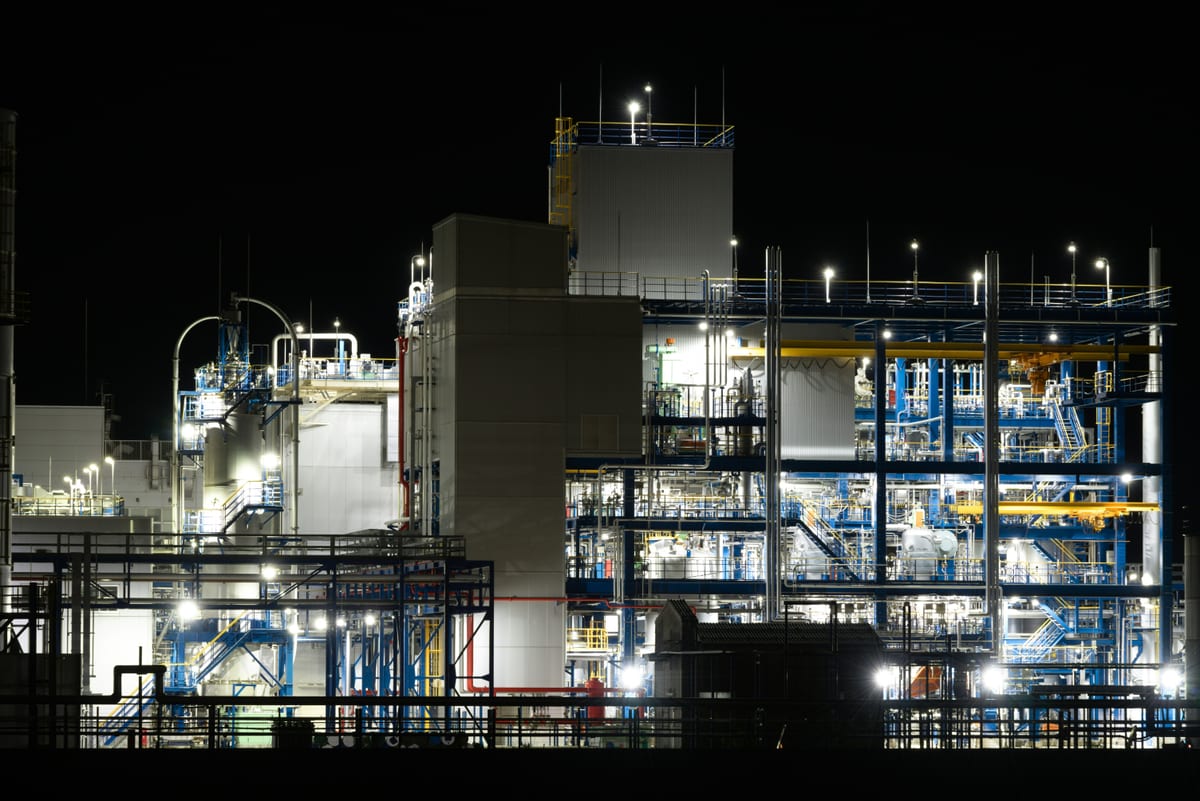
The Union Cabinet approved the BHAVYA scheme on July 24, committing Rs 3,030 crore to develop three dedicated Chemical Parks across the country, with the Ministry of Chemicals and Fertilizers as the nodal body. This is an industrial infrastructure decision with strategic weight — the sector it targets sits at the intersection of pharmaceuticals, agrochemicals, specialty materials, and every manufactured good that depends on feedstock chemistry.
The architecture of the scheme matters as much as the money. State governments will compete under a Challenge Route, meaning the parks go to states that demonstrate investment readiness, not political weight. The Centre facilitates; the states build. Three parks, not thirty. That deliberate narrowness signals the government has studied what went wrong before.
The Import Problem No One Likes to Say Out Loud
India's chemical sector has run a structural deficit for years, with China the dominant supplier of specialty and bulk chemicals that feed everything from pesticide formulations to active pharmaceutical ingredients. Any supply disruption in Zhejiang or Shandong reverberates through factories in Ankleshwar and Hyderabad within weeks. The Galwan confrontation in 2020 made that fragility vivid — fertiliser exports from China were watched with quiet anxiety in South Block even as diplomatic temperature fell. Nothing broke that year, but the near-miss concentrated minds.
What the BHAVYA scheme attempts is structural, not tactical. Individual factory incentives leave manufacturers to solve land, utilities, effluent treatment, and regulatory clearances on their own. In the chemical sector, these are not trivial friction points. A common effluent treatment plant alone can determine whether a cluster of mid-sized chemical manufacturers is viable. Analysts working on industrial cost structures have identified shared utilities and common treatment infrastructure as the single largest cost-reduction lever for MSMEs in chemicals — more impactful, unit for unit, than tax incentives.
Dedicated Chemical Parks pre-solve these problems. A manufacturer arriving at a functioning park finds utilities connected, effluent infrastructure shared across tenants, and regulatory clearances processed at cluster level rather than factory by factory. That reduction in transaction cost converts a distant manufacturer — particularly a European or Japanese chemical company looking to diversify away from a single-country supply chain — from observer into anchor investor.
The Challenge Route as Administrative Memory
The decision to use a Challenge Route rather than administrative allocation reflects a lesson from the Special Economic Zone experience. India designated dozens of SEZs over two decades; many exist today as land banks or partially occupied zones, their original logic intact but execution hollowed out by poor site selection, state government indifference after designation, and the absence of any mechanism to penalise underperformance. The Challenge Route inverts that dynamic. States must demonstrate capacity before funding flows, not after.
There is also geographic logic in the design. The evaluation criteria, if written well, will weight proximity to existing chemical clusters and port infrastructure. Gujarat's Dahej corridor, the Andhra Pradesh coastline, and Maharashtra's petrochemical belt are not accidents of geography — they accumulated decades of ancillary industry, skilled labour, and logistics networks. A Chemical Park dropped into a landlocked district with poor connectivity would merely add to the stock of announced-but-inert industrial zones. The scheme's designers appear aware of this. Whether the evaluation criteria make it explicit is the implementation question that will determine outcomes.
The Governance Fault-Line
The more durable structural risk lies in governance continuity. Central funding disbursed to state-level Special Purpose Vehicles has a documented failure mode: when state governments change mid-project, the SPV loses its political champion, bureaucratic attention shifts, and disbursements stall. National Investment and Manufacturing Zones offer the most instructive precedent — several were notified, boundaries drawn, brochures printed, and then quietly forgotten as state priorities rotated.
A milestone-linked disbursement mechanism — where the Centre releases tranches only on verified physical and regulatory progress — would substantially reduce this risk. Equally important is the SPV governance structure. If the park entity is staffed by state government deputation and subject to normal government procurement cycles, it will move at government speed. If it is ring-fenced with an independent board, professional management, and a single-window clearance mandate backed by state law, it can move at investor speed. Those are not the same thing, and the difference is often the difference between a park that fills up and one that hosts weeds.
Takshashila Institution's industrial policy researchers have consistently flagged whether chemical park governance is insulated from routine state bureaucratic interference as the determinant of whether park-based industrial policy concentrates investment or merely disperses risk. The BHAVYA implementation rules will need to answer this directly.
Who Is Watching From Across the Water
BHAVYA arrives during a global reshoring moment. European and American chemical companies, scorched by supply chain concentrations exposed during the pandemic and subsequently by geopolitical friction, are actively scouting alternative manufacturing bases. India has appeared on those shortlists and repeatedly lost to Southeast Asian competitors on infrastructure readiness and regulatory predictability. The park model addresses the first. The Challenge Route, if it produces genuinely investment-ready sites with functioning utilities and environmental clearances, removes the argument that India requires a three-year setup period before production begins.
The pharmaceutical connection amplifies the strategic weight. India's generics industry depends on bulk drug intermediates, the majority from Chinese manufacturers. Any disruption — from trade policy, geopolitical escalation, or a regulatory crackdown on Chinese chemical plants — lands immediately in Indian medicine prices and export commitments. A functioning domestic chemical park hosting bulk drug intermediate producers would partly insulate that chain. Not completely — the economies of scale that Chinese producers have built over thirty years cannot be replicated in a decade — but meaningfully enough to reduce the single-source dependency that currently runs through the sector.
What Execution Actually Requires
Three parks is a manageable number. It concentrates attention, limits disbursement risk, and creates the possibility of genuine flagship status for winning states rather than diffuse mediocrity. The Rs 3,030 crore allocation, directed at shared infrastructure rather than individual firm subsidies, is the correct use of central money in a sector where the bottleneck is collective infrastructure, not individual capital.
The determinants of success are now largely administrative: port-proximate site selection, independent SPV structures with professional management, milestone-linked fund release, and evaluation criteria that reward investment readiness over political access. None of these require additional legislation. India's chemical import bill and pharmaceutical supply chain security are on the line. That is not a reason for pessimism; it is a reason for precision.