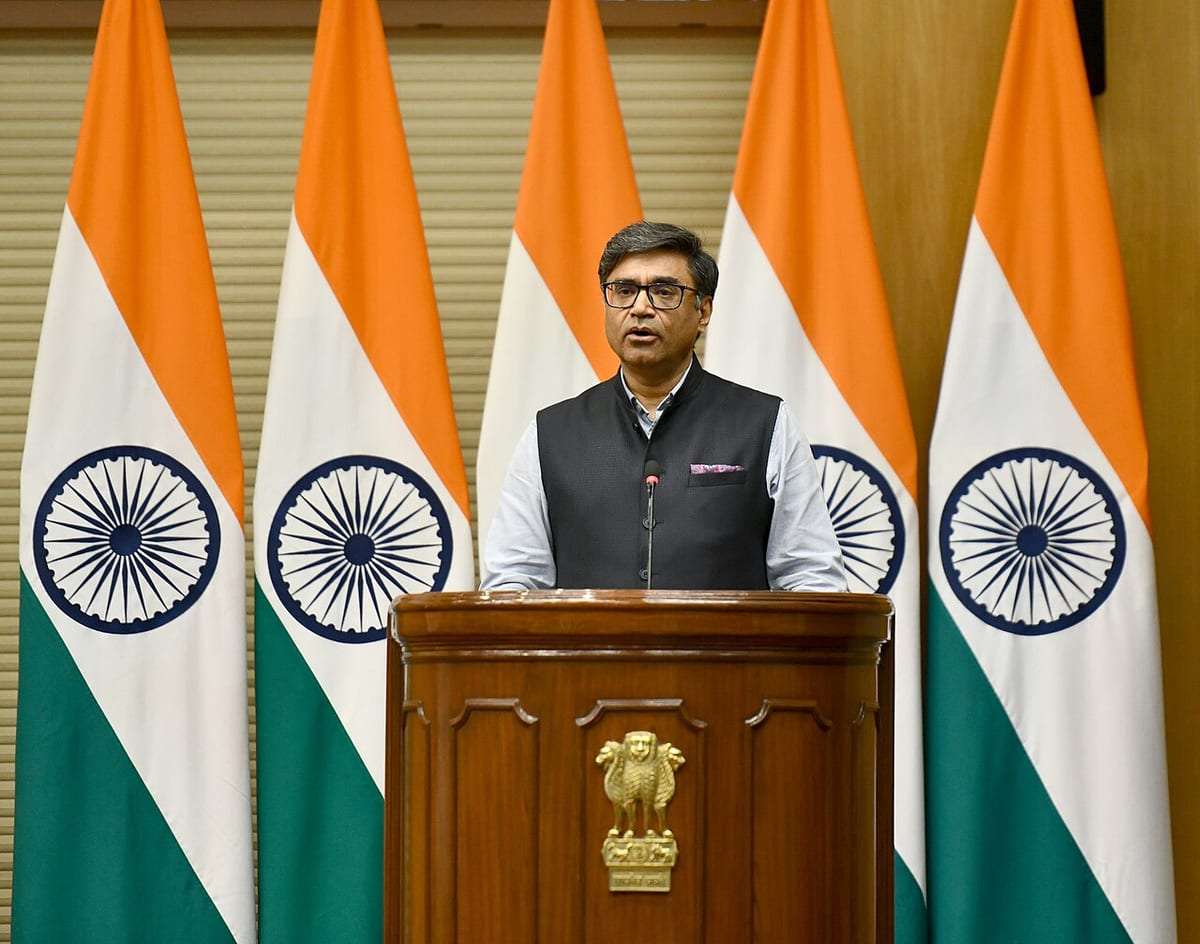
An assistant professor at the Indian Institute of Science (IISc) Bengaluru has opened a discussion about what engineering education in India should mean in an age shaped by artificial intelligence. Prathosh AP's remarks, made in a video on his X account, describe IIT students, including those who performed well in the Joint Entrance Examination, approaching him to study Sanskrit and shastras.
"I'll tell you what, some of my IIT students are studying shastra with me today," he says in the video. The line has been widely shared as evidence that even top-ranked technical minds are seeking grounding in older intellectual traditions. His central claim challenges the default understanding of success at premier institutions: that education should extend beyond landing a high-paying job and accumulating material wealth.
The Argument
Prathosh is not arguing that IIT students should abandon computer science. His point is that logical reasoning, philosophical inquiry and an understanding of human values cannot be separated from technical expertise. He asked why students, having cleared one of the most competitive examinations in the world, should study Sanskrit and traditional Indian texts. His answer, as India Today reported, is that these texts develop intellectual abilities and challenge conventional ideas about success.
He connects this to artificial intelligence, arguing that technological progress requires a deeper understanding of human values and responsibility. Drawing an analogy with the Mahabharata, he suggested that algorithms should be designed to improve human life. He also questioned the consequences of placing powerful technologies in the hands of people without an understanding of dharma.
What gives the remarks weight is that these are students who did not reject the system. They cleared JEE, entered IITs, and then chose to attend a Sanskrit class. That sequence undermines the dismissal that shastra study is an escape for those who cannot handle calculus. The demand comes from inside the institution.
An IISc assistant professor making this argument matters because it comes from within the scientific establishment, not from a cultural advocacy group. The messenger is a member of India's premier technical research community, which carries different weight than if a social commentator had raised it.
Why the Video Travelled
This view has support inside Indian higher education. The effort to blend traditional knowledge systems with modern technical curricula has received policy-level attention. The premise is direct: India's engineering education produces the architects of its digital economy, and those architects need more than code to design systems that serve a billion people.
New Delhi has created institutional pathways to encourage this kind of curriculum experimentation. The question is no longer whether such a synthesis is permissible; it is whether it can be evaluated honestly.
The professor's framing deserves attention for another reason. He is not advocating a retreat from technical rigour. He is arguing that the philosophical apparatus of shastras can supply a missing layer in AI education, one that asks what an algorithm should do, not merely how efficiently it can do it. That distinction matters for a country positioning itself as a responsible digital power.
The Tension Between Rigour and Roots
The risk lies in execution. An overemphasis on cultural texts, if made mandatory or ideological, could erode the hard skills that give Indian engineers their competitive advantage. Placement outcomes, startup quality and the ability to build competitive AI systems depend on mathematical depth and systems thinking. Institutions must add this philosophical layer without reducing the technical core.
The viral moment reveals a generation of students choosing to ask older questions. That some IIT students, after surviving JEE preparation, are seeking out Sanskrit and shastras suggests a demand the curriculum has not been meeting. It is a signal about student curiosity.
Global AI governance debates often default to Western ethical frameworks. India's attempt to bring shastra concepts into AI design is a bid to contribute an alternative vocabulary. Whether that vocabulary proves rigorous enough for international technical standards remains unclear.
The conversation also raises a question: who gets to decide what an engineer must know. Students choosing shastras voluntarily is one thing; a mandated curriculum is another. The academic freedom of institutions to experiment without central direction will determine whether this moment becomes meaningful pedagogy or collapses into rhetoric.
What This Means for Indian Engineering
The discussion arrives at a critical juncture for India's technology ambitions. The country wants to lead in AI, not serve as a back office for global code. That requires a workforce capable of reasoning about autonomy, bias, accountability and the public interest. A technical-only training pipeline produces engineers who can build models. A training pipeline that includes ethics and logic produces engineers who can be trusted with them.
Indian institutions already have flexible elective structures. Pilot courses on Indian logic and ethics for AI students, evaluated for learning outcomes without compromising core technical benchmarks, would test this approach. If such electives show that students develop stronger reasoning and better design instincts, the case for broader integration becomes clear. If they do not, the argument remains a cultural curiosity and the core curriculum stays unchanged.
A larger identity question is at stake. India has spent decades importing pedagogical models from the West, often without asking whether they fit the questions Indian society needs answered. The shastra debate, at its best, is an attempt to define an intellectual identity that is not derivative. At its worst, it is nostalgia dressed as rigour. The test is whether the tradition survives contact with the demands of building real AI systems.
What should Indian readers take from this? The IISc professor has not supplied a syllabus. He has issued an invitation. The students who accepted it chose to do so after proving their technical competence at the highest level. That sequencing matters. If Indian engineering education can hold both the shastra and the compiler, it will produce a different kind of engineer, one who can ask why an algorithm should exist before writing the code that brings it into being.