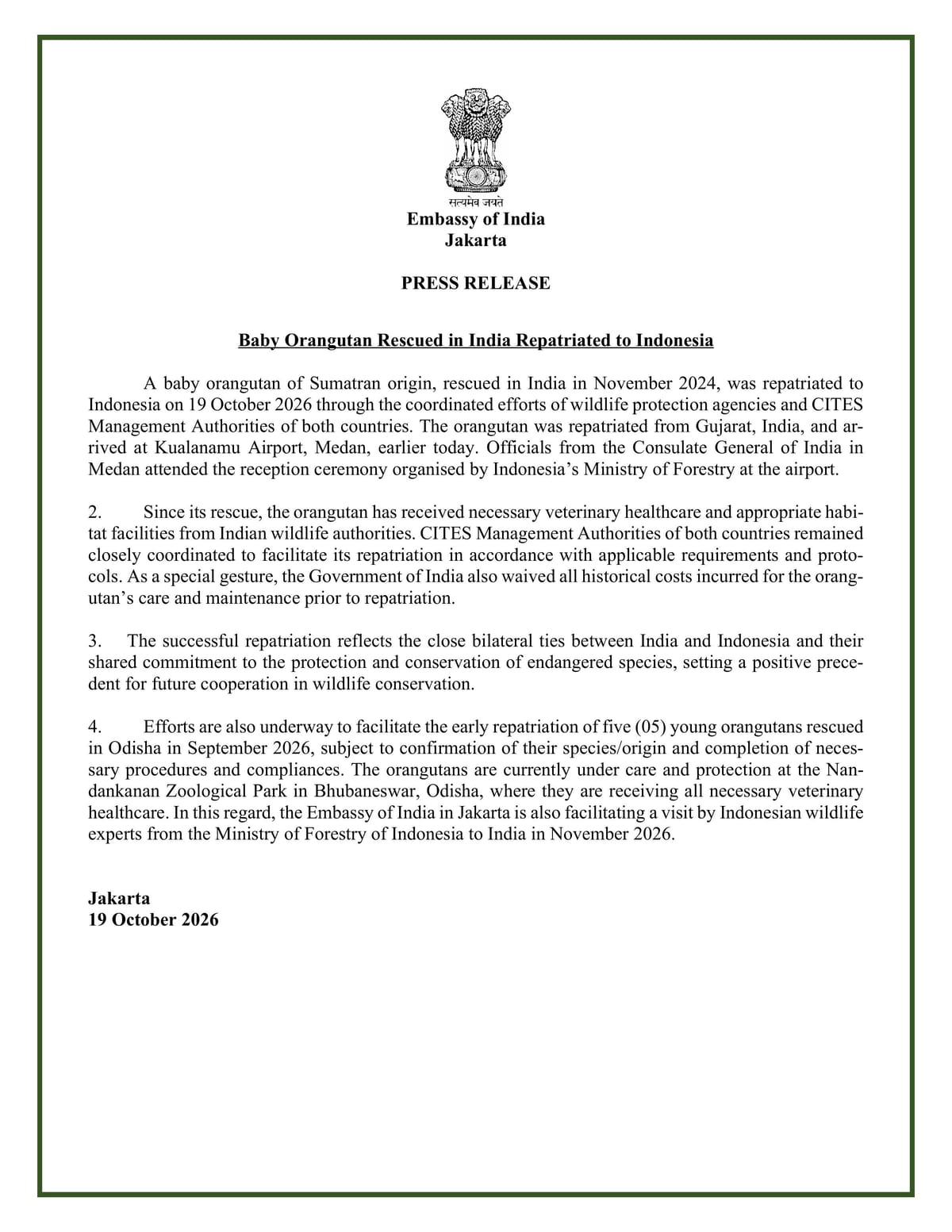

The Federation of Indian Pilots has written to Prime Minister Narendra Modi, calling for the establishment of a statutory, autonomous Civil Aviation Authority to replace the current regulatory architecture centred on the Directorate General of Civil Aviation. The letter, sent by FIP President Capt. Amit Singh, argues that the DGCA's dual function, advising on aviation policy while simultaneously enforcing safety standards, creates an inherent conflict of interest that India's scale of expansion can no longer safely absorb.
India is the world's third-largest domestic aviation market, with passenger traffic projected to reach 300 million annually by 2030 and over a thousand aircraft on order across IndiGo, Air India, and other carriers. A regulatory framework designed when Indian aviation was a thin, state-dominated sector is now presiding over one of the world's fastest-growing aerospace ecosystems. The FIP's petition calls for institutional design to match commercial reality.
The Problem With Wearing Two Hats
The DGCA operates under the Ministry of Civil Aviation, which means the body responsible for airworthiness inspections, pilot licensing, and incident investigation answers, ultimately, to the same political authority that announces airline capacity expansions, inaugurates new airports, and celebrates record passenger numbers. These are not naturally compatible functions. A ministry with a political incentive to present the aviation boom as a success story is not structurally inclined to empower an oversight body whose first serious act might be grounding aircraft belonging to a carrier with political connections.
The SpiceJet airworthiness crisis of 2022 illustrated how enforcement action arrives late inside a ministry-led oversight system; the DGCA's interventions followed a sustained period of documented safety violations rather than preceding them. Capt. Singh's letter identifies this pattern as structural rather than accidental, the product of an architecture in which technical safety decisions cannot be fully insulated from executive preference.
Former DGCA chief Arun Kumar acknowledged in public statements after his tenure that the directorate faces chronic resource constraints that an autonomous authority, funded by aviation-sector levies rather than budget allocations, could address. Parliamentary Standing Committees on transport have flagged inadequate staffing and inspection capacity within DGCA. These are long-standing institutional deficits that have survived successive governments because the ministry has never faced a binding obligation to resolve them.
What ICAO Requires and What India Provides
The International Civil Aviation Organization's Universal Safety Oversight Audit Programme sets out clear expectations for the structural independence of national aviation regulators. The audits assess whether the regulatory body has the legal authority, organisational independence, and technical capacity to enforce safety standards free from external interference. India's current model, in which DGCA is a subordinate office of the Ministry of Civil Aviation, sits uncomfortably against these standards.
The practical consequences of a gap between India's regulatory architecture and ICAO expectations are not abstract. Bilateral air services agreements, the legal instruments that govern which Indian carriers can fly where, at what frequency, and under what conditions, are sensitive to the credentialing status of the national regulator. An ICAO finding that India's oversight architecture lacks structural independence would complicate the international route ambitions of Air India and IndiGo at precisely the moment when both carriers are making long-haul expansion their strategic priority. The FIP's letter is, read this way, as much a commercial argument as it is a safety one.
The Regulatory Gap India Has Already Closed Elsewhere
India's 2022 National Civil Aviation Policy gestures toward modernising regulatory architecture, but stops short of mandating a fully autonomous Civil Aviation Authority. The gap is visible when aviation is placed alongside sectors where India has already resolved the same tension.
The Telecom Regulatory Authority of India and the Central Electricity Regulatory Commission both exist as statutory bodies independent of the ministries whose sectors they oversee. Neither is perfect; both face political friction in moments of consequential decision-making. But both possess security of tenure for their leadership, ring-fenced budgets, and the legal standing to issue binding orders without ministerial countersignature. The DGCA has none of these things. The comparison is instructive not because TRAI or CERC are models of regulatory perfection, but because India has already accepted, in sectors of comparable strategic weight, that ministry subordination is inadequate governance design. Aviation receives more passengers, carries higher physical safety stakes, and operates under more complex international legal obligations than either telecom or electricity, yet its regulator is structurally weaker than either of theirs.
Observer Research Foundation analysts and researchers at ICIER have previously noted this asymmetry in India's infrastructure regulation; the FIP's petition gives it a specific institutional demand.
What an Autonomous CAA Would Actually Require
The FIP's structural demand, a statutory Civil Aviation Authority, implies a specific legislative architecture. A Civil Aviation Authority Act would need to create a body with its own legal personality, a board appointed through a transparent process with fixed, non-removable terms, and a budget derived from aviation-sector fees and levies rather than from annual ministry allocations. This last element is not procedural detail; it is the load-bearing element of the entire structure. A regulator whose annual budget depends on ministerial goodwill cannot enforce against carriers that carry political weight. Fee-funded independence is the mechanism by which technical judgment survives political preference.
The Ministry of Civil Aviation under Kinjarapu Ram Mohan Naidu has not responded formally to the FIP's letter and has not committed to separating regulatory functions from policy functions within DGCA. The ministry's energies have been directed toward the UDAN regional connectivity scheme and facilitating the mega aircraft orders that have made India's aviation expansion visible to global markets. Expansion and governance reform are not mutually exclusive, but they do compete for political bandwidth, and expansion is the more photogenic of the two.
The Compounding Risk of Delay
India's ambition, stated across multiple policy documents and official speeches, is to be a global aviation hub by 2047. That ambition is built on a foundation of continued growth in passenger numbers, expanded international connectivity, and the commercial success of Indian carriers on routes that currently belong to Gulf airlines and European majors. None of this is impossible; the demand fundamentals are real and the fleet orders are contracted. But a hub is not just a place where many flights land; it is a place where the regulatory and safety reputation of the presiding authority commands international confidence. No airline alliance, no bilateral traffic rights agreement, and no insurance syndicate treats a ministry department and an independent statutory regulator as equivalent. India is accumulating the physical infrastructure of a hub while retaining the regulatory architecture of an earlier, smaller era.
The FIP has identified this gap and placed it formally before the Prime Minister's Office. The structural argument the pilots are making is the same one that infrastructure economists have advanced for years: the later the correction arrives, the more expensive it becomes, because the distortions accumulate and the vested interests deepen. India's aviation sector at the current moment, expanding, credentialed, internationally ambitious, is better placed to absorb the transition to an autonomous regulator than it will be after a serious incident forces the reform under conditions of crisis. The question the government must now answer is whether it will lead that transition deliberately, or wait for circumstances to demand it.