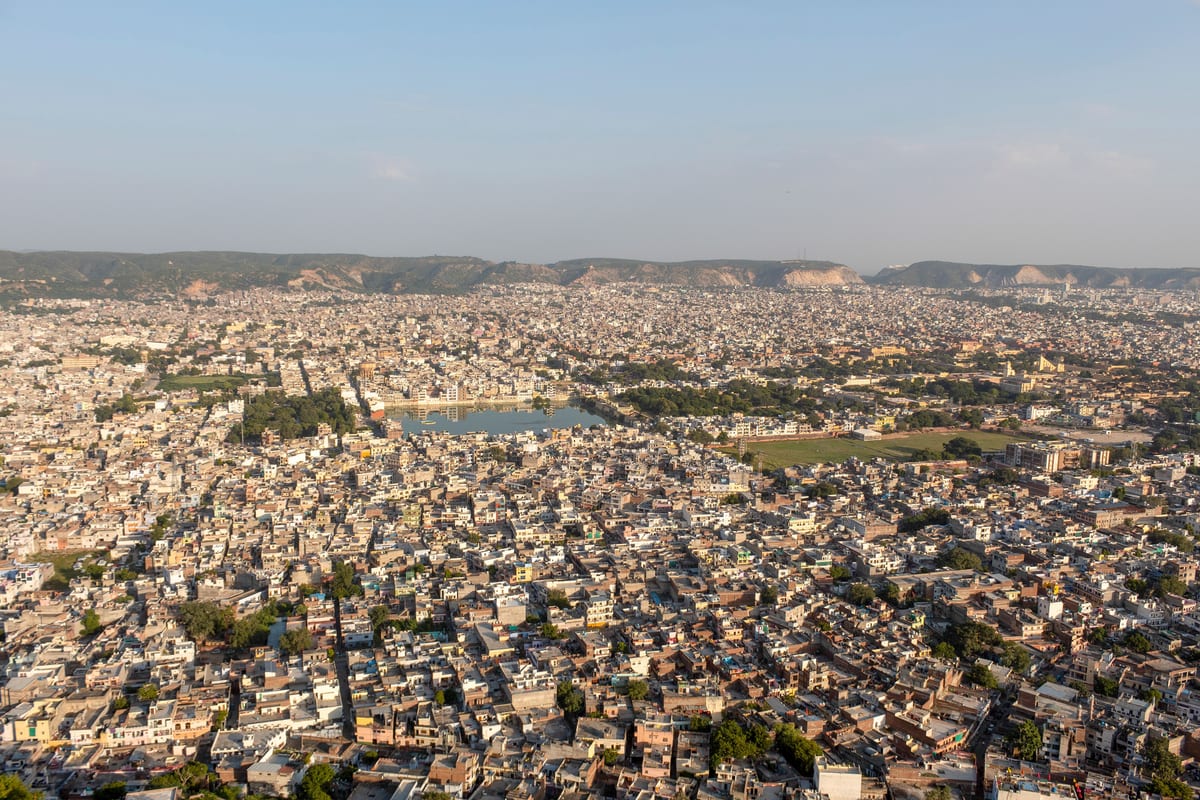
There is a moment, usually somewhere between the Hawa Mahal and the old cloth market of Johari Bazaar, when Jaipur stops being a destination and becomes a feeling. The sandstone glows. The air carries turmeric and marigold. A cycle-rickshaw negotiates its way past a jewellery shop whose owner could, without exaggeration, trace his trade back several generations. This is simply Tuesday in Jaipur.
A City Born of Genius and Ambition
Jaipur was founded in 1727 by the Kachhwaha Rajput ruler Maharaja Jai Singh II, who named the city after himself. What made Jaipur extraordinary for its time was not just royal patronage but deliberate intellectual design. The Maharaja commissioned the scholar-architect Vidyadhar Bhattacharya to plan the city according to the principles of Vastu Shastra, the ancient Indian science of spatial harmony. The result was a grid of nine rectangular blocks, two reserved for state buildings and palaces, seven for the public, enclosed within fortification walls and punctuated by grand gates. Incredible India notes that Jaipur is believed to be India's first planned city of the Common Era. This was not improvised. It was imagined whole.
That founding ambition echoes across three centuries. Today Jaipur is a bustling modern metropolis, the capital of Rajasthan, and one of the three points of the Golden Triangle, the circuit of Delhi, Agra, and Jaipur that introduces millions of visitors each year to North India's heritage. But Jaipur is not merely a stop on a circuit. It is an argument: that India's cities were sophisticated, intentional, and deeply rooted in philosophical frameworks long before anyone else arrived to tell the story differently.
The Pink That Was Never Just a Colour
In 1876, Maharaja Ram Singh ordered the entire city painted pink to welcome the Prince of Wales. Pink, in Rajput tradition, is the colour of hospitality. The gesture was so definitive that Jaipur's buildings are still required to maintain that pink hue today, giving the city its nickname: the Pink City. Walk the old city at golden hour and you will understand why this was never a gimmick. The warm terracotta-pink of the sandstone structures catches the evening light in a way that feels almost orchestrated, as though the city itself has been performing for centuries.
Forts, Palaces, and the Weight of Living History
Jaipur's heritage is carried in stone with uncommon grace. The City Palace sits at the heart of the old city, a complex of courtyards, pavilions, and museums that still houses members of the royal family, making it perhaps the most lived-in royal palace in India. The Hawa Mahal, with its 953 latticed windows designed to allow royal women to observe street life unseen, is one of the most recognisable silhouettes in Indian architecture. The Amber Fort, perched on a ridge above Maota Lake, combines Hindu and Mughal architectural elements in a conversation of styles that reflects the complex history of Rajputana. The Jantar Mantar, the great astronomical observatory also built by Jai Singh II, is a UNESCO World Heritage Site, a collection of massive masonry instruments that once computed the position of celestial bodies with startling precision. These are not ruins. They are evidence.
A Cuisine That Tells Its Own Story
No visit to Jaipur is complete without surrendering entirely to its food. The culinary heritage of the city reflects Rajasthan's cultural diversity. Dal Baati Churma, the Rajasthani platter of lentil curry, ghee-basted wheat dumplings, and sweet crumbled dessert, is not merely a dish but a philosophy of sustenance: robust, generous, and built for the landscape. Laal Maas, the fiery mutton curry of red chillies and aromatic ghee, is for those who want the full heat of the desert on their palate. Street food lovers will find Mirchi Bada, batter-fried green chillies stuffed with spiced potato, at almost every corner, alongside Kachoris that arrive hot from the kadhai with a complexity of spicing that defies their humble appearance. During festivals, Ghevar, a latticed sweet soaked in sugar syrup, appears in shop windows like edible architecture. The food of Jaipur, like the city itself, was designed to make an impression that lasts.
Practical Travel: Getting There and When to Go
Jaipur is well connected to the rest of India and to international destinations. The Jaipur International Airport (JAI) receives regular domestic and international flights, and the city is also served by Jaipur Junction Railway Station (JP), a busy hub on India's rail network with excellent connectivity to Delhi, Mumbai, and other major cities. Road travel from Delhi, approximately five hours, is comfortable on the Delhi-Jaipur Expressway, making it an easy addition to any Golden Triangle itinerary.
In terms of timing, the cooler months between October and March offer the most comfortable conditions for exploration. January temperatures range from around 3.5°C to 27.6°C, crisp and ideal for long days of fort-climbing and bazaar-wandering. April through June see temperatures soaring above 40°C, which is formidable but not impossible if you are determined. The monsoon, from July to September, brings relative relief and a green, dramatically atmospheric edge to the landscape, though some outdoor experiences are better suited to dry weather.
Why Jaipur Is More Than a Heritage Destination
What sets Jaipur apart from merely beautiful old cities is its refusal to be only historical. The gems and jewellery trade for which it is world-renowned still operates out of the same streets where it has always operated. The artisans producing block-printed textiles, blue pottery, and lac bangles are working in traditions that predate the city's founding. The bazaars, Johari Bazaar, Bapu Bazaar, Tripolia Bazaar, are not reconstructed for visitors. They are functional, chaotic, and alive.
Jaipur reminds you, if you are paying attention, that India's civilisational story was never interrupted, only occasionally misread by those passing through too quickly. Come slowly. Stay longer than you planned. Eat the kachori while it is still hot. The Pink City has been welcoming strangers for three centuries. It is very good at it.