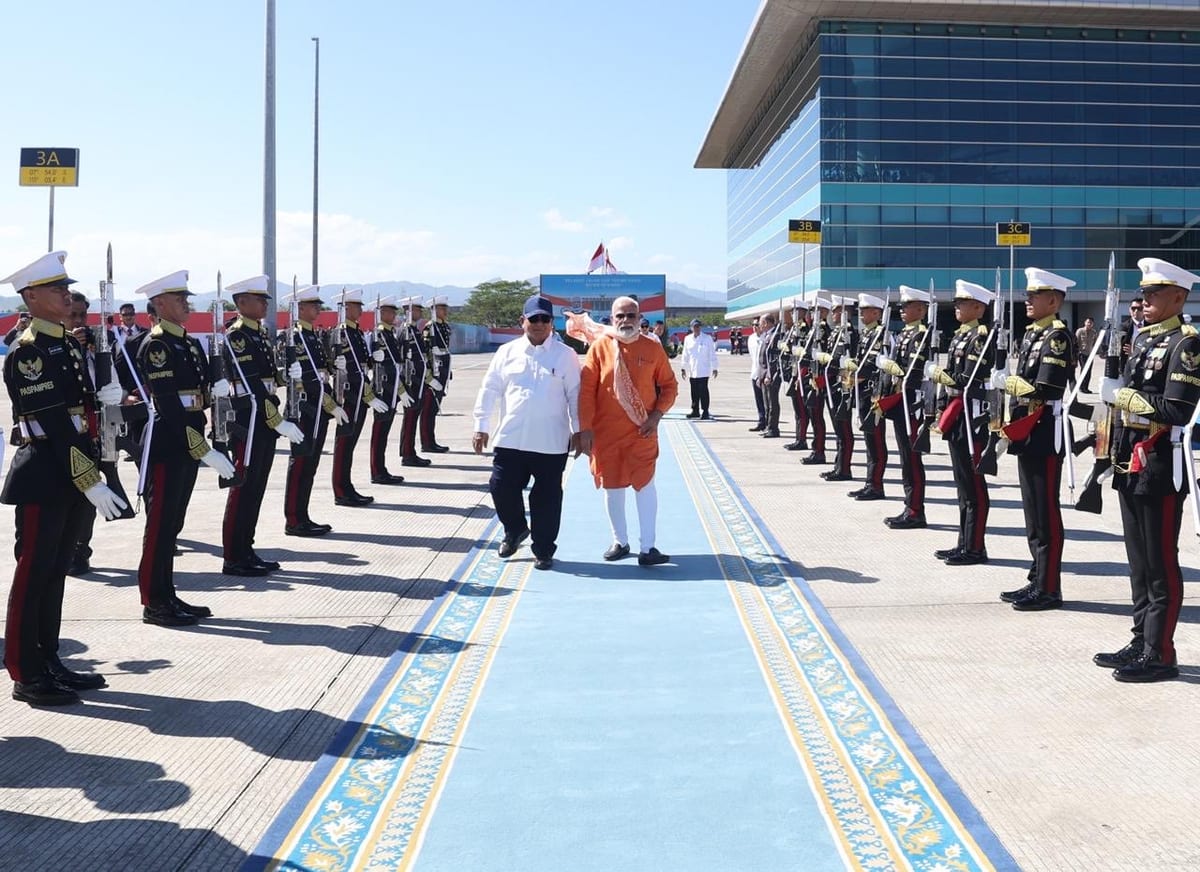
When Prime Minister Narendra Modi stood before the Indonesian parliament on Tuesday and recalled how Biju Patnaik flew a Dakota aircraft through Dutch anti-aircraft threats to extract Indonesian leaders to safety in 1947, he was constructing a historical claim — that India's relationship with Jakarta predates, and therefore exceeds, any transactional partnership that a rising China might offer through infrastructure financing. Modi became the first Indian prime minister to address the Indonesian parliament, and the choice of forum was deliberate: parliaments confer legitimacy, not merely bilateral warmth.
The facts Modi cited anchor the argument. In July 1947, Jawaharlal Nehru — not yet officially India's prime minister — ordered a covert operation, tasking Patnaik and his co-pilot wife Gyanwati with flying Indonesian prime minister Sutan Sjahrir and vice president Mohammad Hatta from a Dutch-occupied archipelago to New Delhi via Singapore. Eight years later, at the 1955 Bandung Conference — where 29 newly independent Asian and African nations convened — Nehru and President Sukarno together declared that sovereign nations hold the right to make their own decisions, laying the groundwork for the Non-Aligned Movement. Modi summoned both episodes as evidence of a prior moral architecture: India stood with Indonesia before it had anything material to gain from doing so.
Development, Not Expansionism — and Who Is Not Named
The sharpest line in Modi's address was also the most carefully phrased. India pursues a path of development, not expansionism, he told Indonesian lawmakers — a formulation that requires no attribution to land its meaning in a chamber where Southeast Asian anxieties about Chinese behaviour in the South China Sea and the Indo-Pacific run deep. The speech named no adversary. It did not need to. Indonesia's maritime equities in the region, its membership in ASEAN, and the daily reality of Chinese assertiveness in adjacent waters supplied the subtext that Modi's words pointedly declined to provide.
This is a practiced technique in Indian diplomatic communication — the assertion of principle where the contrast writes itself. The Bandung Conference of 1955 never named colonial powers by identity, yet every participant understood precisely which nations the summit positioned itself against. Modi's invocation of that legacy at the Indonesian parliament is not nostalgia. It is a claim that India's multilateral instinct differs structurally from Western conditionality-based engagement on one side and Chinese transactional infrastructure diplomacy on the other. Whether Jakarta's political class finds that differentiation credible depends less on the speech than on what follows it.
The Strategic Geometry of the Eastern Indian Ocean
India's interest in Indonesia extends beyond trade figures or soft-power goodwill. The archipelago sits astride the Malacca Strait — the chokepoint through which a dominant share of India's energy imports transit — and its northernmost territory at Sabang sits at the western entrance to that passage. Discussions around Indian access to the Sabang port for naval logistics purposes have circulated within bilateral diplomacy for years. Analysts tracking Indian foreign policy have flagged this as one of the most structurally significant pending deliverables in the relationship. Should those discussions advance toward a formal arrangement, India would gain a logistics node that extends its effective naval presence east of the Malacca Strait — a shift of considerable consequence for how India manages its sea-lane security in the Indian Ocean Region.
Harsh V. Pant of the Observer Research Foundation has argued that India's Act East Policy requires Indonesia as its anchor state, given Jakarta's central role in ASEAN decision-making. That observation cuts to the core of the strategic arithmetic. ASEAN does not move as a bloc on security matters, but Indonesia's weight within it — as the largest economy, the largest population, and the country with the most direct South China Sea exposure — means that a substantively upgraded India-Indonesia relationship reshapes the regional order in ways that a series of smaller bilateral upgrades cannot replicate. A Jakarta that views New Delhi as a credible development and security partner changes ASEAN's internal calculus on how to manage Chinese pressure.
The Critical Minerals Thread
Indonesia holds some of the world's largest reserves of nickel — a critical input for the electric vehicle battery supply chain. India's energy transition ambitions, anchored in its production-linked incentive schemes for advanced chemistry cells and EV manufacturing, depend on nickel supplies that the current bilateral architecture does not resolve. A structured critical minerals corridor between the two countries — linking Indonesian reserves to Indian battery manufacturing capacity — would serve both nations' industrial interests while creating supply-chain interdependence that deepens the relationship beyond the ceremonial.
This is precisely where the parliamentary address needs to translate into technical-level deliverables. Constantino Xavier of Carnegie India has noted that parliamentary diplomacy of this kind — addressing a foreign legislature directly — is among India's most underused foreign policy tools and signals a new level of bilateral ambition. Ambition declared before a legislature is a promissory note; the question is whether the ministry-level machinery can now convert it into a bilateral investment treaty framework, a critical minerals agreement, and a maritime cooperation structure that gives institutional form to what the speech announced as political intent.
Bandung as a Living Doctrine
The deeper intellectual move in Modi's speech is the rehabilitation of Bandung as an active framework rather than a historical curiosity. The Non-Aligned Movement that grew from the 1955 conference fell into disrepair after the Cold War's end, when the absence of two competing blocs seemed to eliminate the strategic premise of non-alignment. What Modi's address suggests — implicitly but unmistakably — is that a new version of that premise has re-emerged. The Indo-Pacific now features a distinct structural competition between a US-led security architecture and a China-centred connectivity architecture, and smaller and mid-sized nations across Southeast Asia face pressure to choose sides.
India's answer to that pressure, as articulated in Jakarta, is the Bandung formulation updated: sovereign nations hold the right to make their own decisions, and India's partnerships come without the conditionality that Western engagement sometimes attaches and without the debt-leverage that Chinese infrastructure financing has generated in several recipient countries. Happymon Jacob of the Centre for International Strategic Studies has noted that invoking Nehru's UN advocacy for Indonesian independence is a deliberate soft-power move that differentiates Indian multilateralism from the alternatives on offer. The differentiation is credible as rhetoric. Making it credible as policy requires that India's development financing capacity — its Exim Bank lines of credit, its digital public infrastructure exports, its technical assistance programmes — scale to meet the ambition the speech articulates.
For Indian policymakers reading the Jakarta address in the context of the broader Indo-Pacific competition, the most instructive takeaway may be this: the Bandung legacy is a depreciating asset if it remains purely rhetorical. The countries of Southeast Asia watched China build ports, roads, and telecommunications infrastructure across their region over two decades; they were not persuaded by historical invocations alone. India's civilisational memory of standing with Indonesia in 1947 is a genuine differentiator — but only if it is the opening statement of a structural relationship, not the closing argument. The Dakota aircraft that Biju Patnaik flew through Dutch threats was an act of conviction backed by physical risk. The test of the parliamentary address is whether the institutions behind it are prepared to take comparable risks with capital, logistics, and strategic commitment.