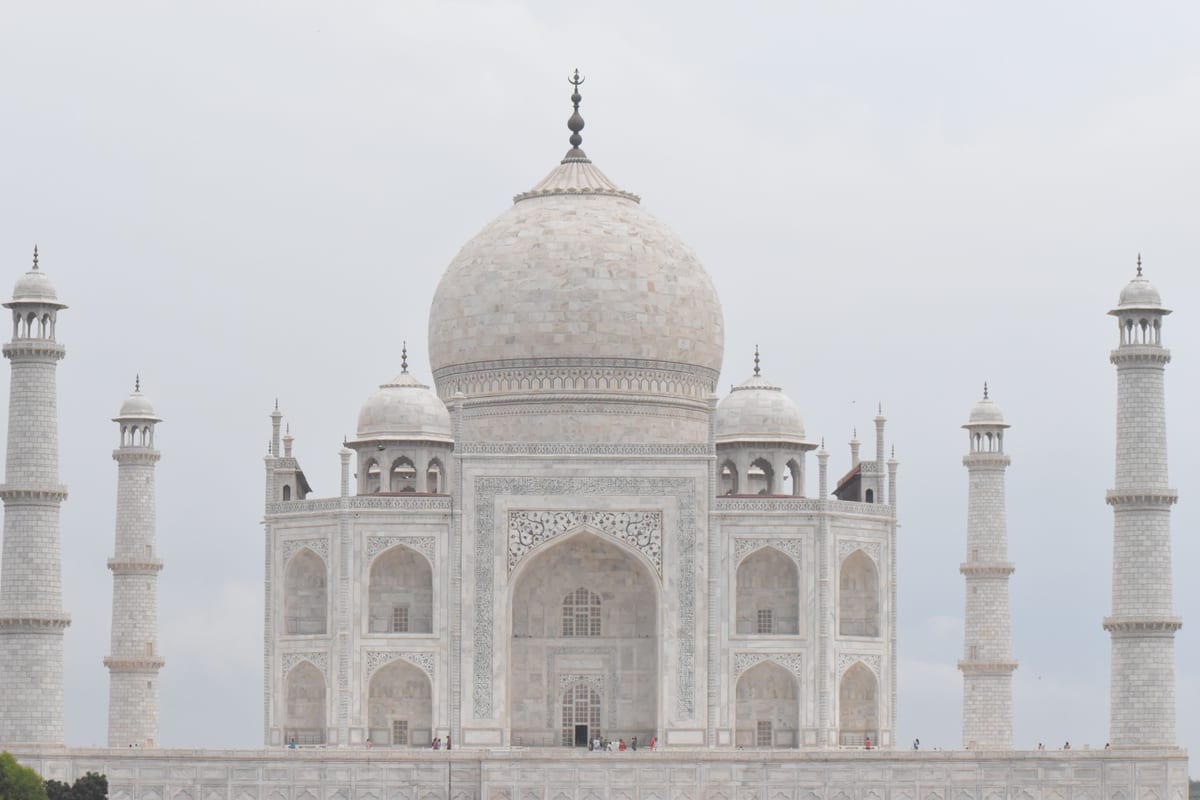
The Taj Mahal stands in Agra as something India has rarely needed to explain — a monument so visually sovereign that its silhouette functions almost as a second national seal. That it should now require the Archaeological Survey of India and the Union government to appear in court and file a formal counter-affidavit defending its own historical identity is a measure of how far the juridification of India's heritage system has travelled. The Allahabad High Court on Monday directed the Centre and the ASI to respond to a writ petition seeking a declaration that the Agreshwar Mahadev Nagnatheswar Virajman Tejo Mahalaya temple is present inside the Taj Mahal premises — a claim that Indian courts and the ASI have repeatedly declined to endorse, but which keeps returning through fresh procedural avenues.
The Procedural Thread
The immediate trigger is a writ petition filed on July 3 by the Tejo Mahalaya temple, advocate Hari Shankar Jain, and four others. Jain argued before Justice Rohit Ranjan Agarwal that a lower-court application to appoint an advocate commissioner — and to permit photography of the disputed premises — had been wrongly rejected by the trial court, and that a subsequent revision petition was dismissed as not maintainable. Justice Agarwal heard the submission and issued notice to the Centre, the ASI, and a fourth respondent, Pankaj Kumar Verma, directing them to file counter-affidavits.
The writ challenges two specific orders from the district courts at Agra: one from the Civil Judge (Senior Division) and one from the Additional District Judge, both of whom had declined to pass an order appointing an advocate commissioner to survey the site. Those refusals traced back to a declaratory suit filed in 2015, still pending before the Civil Judge (Senior Division) at Agra, which seeks a declaration that the Tejo Mahalaya temple is located within the Taj Mahal complex. The petitioners want the ASI to conduct what they called a scientific and historical survey of the monument and to determine, through expert examination, its "true historical character."
The theory that underpins the petition — that the Taj Mahal was originally a Shiva temple called Tejo Mahalaya before the Mughal period and was later converted into a mausoleum — has circulated in various forms since at least the early 1970s. It has not been accepted by the ASI as having any evidentiary or historical basis, and no Indian court has endorsed it. The Supreme Court has previously dismissed similar petitions. The current litigation is part of a series of legal attempts over the years questioning the historical origins of the monument.
What ASI's Counter-Affidavit Must Do
The direction to file a counter-affidavit is a routine procedural step. But the document ASI now prepares carries weight beyond the immediate proceedings, because the strongest rebuttal available to the government runs along two entirely distinct lines.
The first is statutory. The Ancient Monuments and Archaeological Sites and Remains Act, 1958 vests exclusive custodial and investigative authority over protected monuments in the ASI. A court-directed survey by an advocate commissioner — a civil-procedure instrument designed to inspect disputed property in ordinary suits — would subordinate ASI's scientific mandate to a mechanism built for property boundary disputes. Former ASI Director-General B.R. Mani has repeatedly stated that no credible archaeological evidence supports a pre-Mughal Hindu structure beneath the Taj Mahal, and that such claims contradict decades of documented excavation records. That scientific consensus, rooted in ASI's own institutional record, is the foundation of any affidavit the ASI files.
The second line of rebuttal runs through international law. India is a signatory to the UNESCO 1972 World Heritage Convention. The Taj Mahal carries Outstanding Universal Value as a designated World Heritage Site. UNESCO's Operational Guidelines place a binding obligation on State Parties — which India is — to protect a site's integrity from legal or administrative actions that could alter that value. An intrusive survey ordered against the government's own objections would not be domestically anomalous; it would raise the question, in Geneva and Paris, of whether India's stewardship of the site has weakened. Observer Research Foundation analysts have previously flagged this obligation in commentary on similar heritage disputes. The counter-affidavit the Centre files should cite it directly, converting the proceeding from a domestic heritage matter into a case with treaty implications.
The Wider Pattern
The Tejo Mahalaya case does not sit in isolation. It belongs to a cluster of litigations — including the Gyanvapi mosque proceedings in Varanasi and the Krishna Janmabhoomi dispute in Mathura — in which courts have been asked to determine or investigate the pre-Islamic origins of sites that are either currently in religious use or protected under heritage law. Each case has its own procedural history and legal character. But together they have generated what historian Rana Safvi has described as a chilling effect on heritage tourism and India's composite-culture narrative abroad — a concern that international media coverage of the Taj Mahal litigation has already amplified, with outlets including BBC and Reuters framing these cases as a pattern of heritage reidentification.
India's Ministry of Culture has not acknowledged the Tejo Mahalaya claim as having any evidentiary basis. That position is correct and must be sustained. But there is a structural vulnerability that the Taj Mahal litigation exposes: the Places of Worship (Special Provisions) Act, 1991 explicitly exempts ASI-protected monuments from its ambit. The exemption was presumably designed to give the ASI unfettered scientific authority over archaeological sites. What the current wave of litigation suggests is that the exemption, while it removes heritage sites from the Act's bar on suits, does not foreclose declaratory suits in civil courts — and that the interplay between civil procedure and the ASI's exclusive statutory authority has not been definitively resolved by any higher court in a form that binds lower courts to reject such applications at the threshold.
The Soft-Power Dimension
There is a harder calculation running beneath the legal one. The Taj Mahal draws several million domestic and foreign visitors each year and anchors the Incredible India tourism brand in markets from Europe to East Asia. Its image is inseparable from India's pitch as a pluralist civilisational state — one that absorbed Mughal architecture into its national identity as naturally as it absorbed Buddhist and Jain iconography. The monument is not merely a historical object; it is an active instrument of cultural diplomacy, appearing in bilateral summit photography, state-gift selections, and international tourism campaigns.
Any order — even an interim one — that appeared to place the Taj Mahal's heritage status in administrative suspension would register internationally in ways that a Ministry of Culture press release cannot quickly undo. UNESCO's List of World Heritage in Danger is rarely triggered by litigation alone, but a pattern of state inaction in contesting such litigation, or a court order passed against the government's objections, would give the World Heritage Committee grounds to ask formal questions about India's stewardship capacity. India's Ministry of Culture would be well-advised to proactively brief the UNESCO World Heritage Committee, signalling that the government is robustly contesting the proceedings — not as a concession to external scrutiny, but as a demonstration of the confident heritage stewardship India has exercised for decades.
What the Record Now Requires
The Allahabad High Court has done what courts do: it has admitted a petition, issued notice, and asked the state to respond. The government and ASI now have the opportunity — and the obligation — to place on the judicial record a comprehensive rebuttal that does not merely repeat the factual consensus on the Taj Mahal's Mughal origins, but articulates the full legal and international framework within which any survey order would be unworkable. The monument has survived three and a half centuries of weather, conflict, and administrative indifference. Whether India's heritage institutions can build a durable legal architecture that closes off the procedural pathways through which such claims keep returning is a different, more institutional, and ultimately more consequential question.