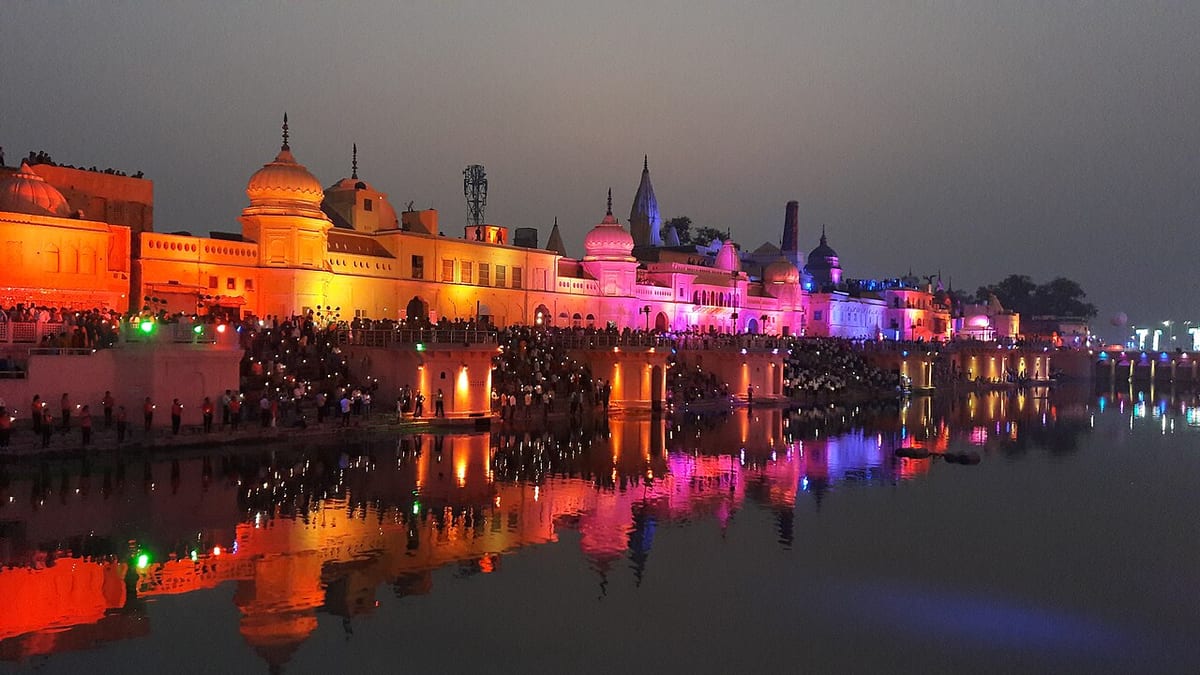
Ayodhya lit more than 30 lakh earthen lamps along the Sarayu ghats on 7 November 2026, a pre-Diwali display that the Uttar Pradesh administration framed as a statement of spiritual and cultural heritage. The illuminated riverfront, part of the annual Deepotsav, drew lakhs of pilgrims to a city that has spent the years since the Ram Mandir consecration rebuilding itself around that single act of faith. NDTV reported that the event added to the spiritual splendour of Shri Ayodhya Dham.
Two days before the lamps were lit, high-resolution radar images of the Ram Mandir complex were released by ICEYE, showing the temple's geometry and the surrounding urban fabric from orbit. The satellite photographs, carried by NDTV, frame the same event twice: once as a glowing riverbank and once as a mapped city. That double framing matters. Ayodhya's Diwali is no longer only a ritual; it is a physical asset with coordinates, sightlines, and crowd-flow implications.
The arithmetic of thirty lakh flames
Thirty lakh small fires are an industrial operation disguised as devotion. Each diya needs clay, a wick, oil or ghee, and a pair of hands to set it down. The number becomes real only through thousands of potters, oil pressers, transporters, and volunteers working across eastern Uttar Pradesh. For the artisans who shape the lamps, the Deepotsav is not a one-night display; it is an order book that arrives weeks in advance. The same holds for the boatmen who carry visitors across the Sarayu, the food stalls that serve the crowd, and the small lodges that fill to capacity. The Uttar Pradesh government has positioned the festival as a signature cultural initiative, but its economic weight lands on this informal supply chain. No single ministry advertises that. The lamps do the marketing.
The infrastructure beneath the glow
A festival of this scale cannot survive on sentiment alone. It needs parking, medical posts, waste collection, and crowd-flow design; the failure of any one of these turns a spiritual gathering into a public-order problem. The Ayodhya district administration, which organises the Deepotsav with state agencies, has paired the ritual calendar with investment in airport capacity, railway platforms, and urban renewal. That pairing matters more than the diya count. A city that can absorb a sudden flood of visitors without civic collapse has a different future than a city that can only produce a beautiful postcard.
The BBC's Diwali coverage this year placed Ayodhya's lights within the wider national festival of lamps and fireworks. Ayodhya's display carries different weight. It has a newly consecrated temple as its anchor, a state government treating the festival as cultural policy, and central government backing the city's development as a religious destination through infrastructure projects. The result is heritage policy delivered as event management.
The economic case runs deeper than one night. Pilgrimage tourism in Uttar Pradesh operates year-round, connecting Ayodhya, Varanasi, and Mathura to the wider Ganga belt. When a city manages a thirty-lakh-lamp evening, it signals to tour operators, hotel chains, and airline schedulers that the destination can handle volume. The state's investment in airport and rail capacity becomes a multiplier, not a sunk cost. Each successful Deepotsav lowers the perceived risk of bringing larger groups, longer stays, and higher-spending travellers.
Soft power begins with a satellite photo
ICEYE's radar images are a small but telling detail. Satellite imagery is usually reserved for military analysis, disaster response, or urban planning. A private Earth-observation firm releasing pre-Diwali images of a Hindu temple is itself a signal that Ayodhya has entered the global visual economy. The temple, the ghats, the lamps travel as pixels to diaspora households in London, Toronto, and Singapore, and to tourists deciding whether to add Ayodhya to an itinerary. Chief Minister Yogi Adityanath has repeatedly championed the Deepotsav as a signature cultural initiative, which is another way of saying the festival is an export product. What the satellite image cannot show is the smell of mustard oil, the heat of thirty lakh wicks, the queue at the railway station. That is the management layer beneath the soft power.
The lamps are the easy part; the city is the project.
The contradiction to manage
A religious festival of this scale always sits on a tension. A display that draws lakhs can overwhelm the quiet purpose that brings a single devotee to the Sarayu. Crowd management, sanitation, and accessibility are not afterthoughts; they are the difference between a city that can carry its own ambition and one that breaks under it. The Deepotsav is, in this sense, an exercise in state capacity, but the burden is chosen, not imposed. Uttar Pradesh has chosen to make Ayodhya a mega-pilgrimage hub, and the administrative machinery has been building toward that choice since the temple's consecration.
The alternative is not failure; it is friction. A city that treats the Deepotsav as a one-off spectacle will find its ghats congested, its roads blocked, and its visitors remembering the queue more than the lamp. The Uttar Pradesh government's emphasis on the festival as cultural heritage, not political event, is a useful discipline. It keeps attention on the logistics of reverence rather than theatre of power. That is where the next decade of Ayodhya's growth will be decided: not in the number of diyas lit, but in the number of pilgrims who leave without complaint.
That is the real story behind the figure of thirty lakh. It is not simply that Ayodhya can light more lamps than any other Indian city; it is that the city now has to run like a small metropolis on the nights when it is full.
The 30 lakh diyas will not stay lit beyond the festival. The roads, ghats, platforms, and labour markets they illuminate will remain, and so will the question of whether Ayodhya's infrastructure can keep pace with its symbolic weight. Indian readers should take from this not just an image of devotion, but a working model of how a civilisational city converts ritual into revenue and revenue into resilience. The glow is temporary; the capacity it demands is permanent.