
China is weighing restrictions on exports of solar cells and wafers, the two upstream inputs that India's rooftop solar expansion still imports in bulk, NDTV reported on November 10. The report lands as New Delhi pushes households to install rooftop systems under PM Surya Ghar, a programme whose unit economics depend on stable module prices.
India has made considerable progress in solar module manufacturing. But manufacturing capacity does not mean the country has achieved self-reliance.
The distinction is precise, and it is the entire story. New Delhi has issued no formal statement on Beijing's reported consideration. The existing framework leans on an approved list of models and manufacturers and production-linked incentives for high-efficiency modules. Neither instrument addresses the chokepoint: China supplies the bulk of the cells and wafers that Indian module lines consume.
The NDTV report does not specify which products China may restrict or when. But the direction is enough to unsettle a market that has built expectations of falling solar prices. Solar modules have been the rare energy technology where costs declined for two decades. A Chinese export curb would interrupt that trajectory, and the interruption would land on households before it lands on factories.
The upstream gap
The gap is not capacity; it is chemistry and metallurgy. India assembles modules. Polysilicon, ingots, and wafers remain thin. A restriction on Chinese cells would not merely raise input prices; it would compress the margins of India's module lines and delay rooftop installations. NDTV frames the condition plainly: manufacturing capacity is not self-reliance. Without domestic polysilicon, Indian module makers still buy the most expensive and technology-intensive inputs from abroad, principally from China.
This is not a new vulnerability. Solar manufacturing has a two-tier structure. Tier one is the making of cells and wafers, where capital costs are high, technology is protected, and China holds scale. Tier two is module assembly, where India has expanded quickly because the barriers are lower. A country can double its assembly lines every two years and still find itself hostage to a single supplier for the inputs those lines require. That is the current Indian position.
Rooftop economics
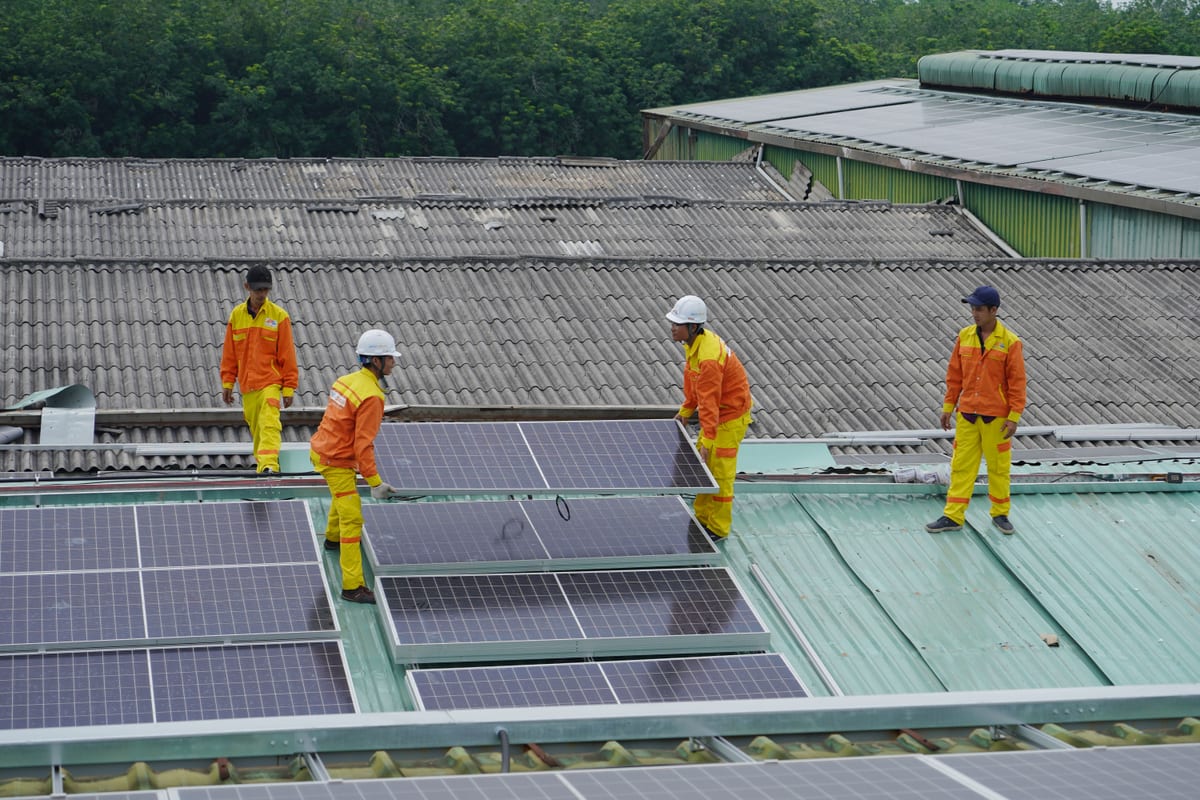
PM Surya Ghar's success depends on households seeing a payback within a few years. If imported Chinese cells become costlier, installers face two choices: absorb the cost or pass it on. Neither is good. Residential adoption slows, and the government's rooftop capacity target becomes harder to reach. The disruption would not be uniform. Urban installers with higher margins can weather a price bump; rural and semi-urban projects, where the scheme's subsidised economics are tightest, would stall first.
PM Surya Ghar offers subsidies for residential rooftop installations, with economics worked out on an assumed module price. If that assumption breaks, the subsidy may need recalibration. State governments that run their own rooftop schemes will feel the pressure first, because their subsidies are shallower and their developer base is thinner.
The installer's ledger is the place to watch. A rooftop installer in Jaipur or Nashik does not debate geopolitics; the installer watches the landed cost of a 540-watt module and the margin on a 3-kilowatt order. If Chinese cells get costlier, that margin shrinks before any policy response arrives. The National Solar Energy Federation of India has long called for a phased manufacturing programme covering the entire solar supply chain. That call predates the current Chinese consideration. The federation's argument is industrial: import dependence on a single country is a business risk as much as a strategic one.
Voices from the sector
Energy economists at IEEFA, including Vibhuti Garg, have argued that India's rooftop solar growth is sensitive to Chinese input costs. The sensitivity is written into the supply chain, not discovered in a policy meeting. Arunabha Ghosh, CEO of CEEW, has kept pressing a simpler point: India must move beyond module assembly into polysilicon and wafers to achieve genuine solar self-sufficiency. The current episode gives his argument a concrete price tag.
These are not abstract warnings. They describe the same imbalance from two angles. Garg concentrates on the consumer: higher input costs slow household adoption. Ghosh concentrates on the factory: without upstream depth, India remains an assembler. Both conclusions point to the same industrial gap.
The global context
Beijing has used export controls before as a tool of industrial policy. The logic is straightforward: restrict the input, raise the price for competitors, and force them to spend more on the same clean-energy transition they advertise as an advantage. India is not the only buyer, but it is the largest market where rooftop solar is scaling fastest. The lesson from rare earths is that restrictions do not need to be permanent to change investment behaviour; the threat alone shifts supply chains.
The structural fault-line
India has achieved scale in solar assembly but not in the high-value upstream stages. That asymmetry leaves the clean-energy transition exposed to external policy swings. A country that can manufacture gigawatts of modules but cannot make the wafers they require has chosen speed over depth. It is not a failure of ambition; it is a sequencing problem. But sequencing problems become cost problems when a dominant supplier tightens supply.
China's dominant position in solar manufacturing gives it negotiating power far beyond any single trade negotiation. Export restrictions on cells and wafers would be a logical extension of controls already applied to critical minerals. India does not need to match Chinese scale overnight. It needs to begin backward integration now, so that the next supply shock meets a more balanced industrial base.
What India can do
India's response should not be limited to diplomatic signalling. The production-linked incentive framework needs to extend backward, not just forward, covering polysilicon, ingots, and wafers. The approved list of models and manufacturers requires enforcement, but enforcement cannot substitute for supply. Long-term supply agreements with producers in Vietnam and Malaysia would diversify dependence while domestic capacity builds. A stockpile of critical inputs is another lever, though storage for polysilicon and wafers is more cumbersome than for modules.
The only durable cure is an end-to-end solar value chain. India has already shown it can scale module assembly; the next test is whether it can scale polysilicon, ingot, and wafer production. That requires capital, technology partnerships, and patience. The production-linked incentive framework is the right tool, but it has so far prioritised modules. A course correction would send a signal stronger than any diplomatic note.
The clean-energy transition is not a choice between import dependence and autarky; it is a choice between one supplier and many. That choice becomes easier as India's upstream capacity grows.
The question for Indian readers is not whether China will restrict exports; it is whether India treats this moment as a supply shock or as a supply signal. A country that built module assembly at scale but not upstream capacity chose speed over depth. The next phase of rooftop solar expansion will require both.