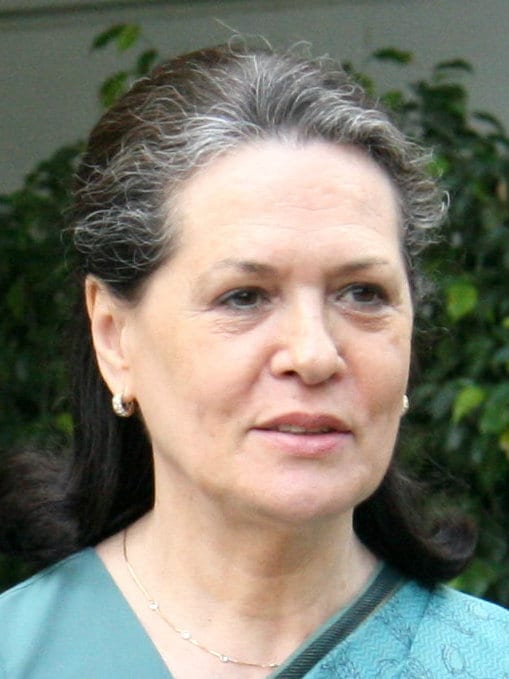
HarperCollins India has released excerpts from Sonia Gandhi's memoir Belonging: A Journey of Love ahead of its November 10 publication, and the passages chosen for public consumption are deliberate. The publisher shared the snippets on X on Friday, selecting episodes that centre on food and family meals rather than the political battles that have defined Gandhi's four decades in Indian public life.
The excerpts recall her arrival from Italy into the Nehru-Gandhi household through the most ordinary of Indian rituals: eating. Tandoori chicken, she writes, was among the first Indian dishes she tried with Rajiv Gandhi, "bright red, slightly charred and set her mouth on fire." The memoir then moves to the thali she would later share with the family: rice, phulkas, a vegetable dish, and mutton, fish or chicken, served on thalis. "And arhar dal, every day," the excerpt states.
HarperCollins India framed the book's arc in a companion social media post:
"The unfamiliar becomes familiar. The familiar becomes loved. Love grows into responsibility. And that is belonging."
"Moving between love and loss, family and power, private life and public duty, Belonging is @SoniaGandhi's account of an extraordinary life – and of a changing India. Belonging releases on November 10, 2026," the publisher added.
The kitchen as political language
Sonia Gandhi has spent much of her career avoiding public speech and letting her silences do the work. The memoir's foregrounding of arhar dal and tandoori chicken is a form of communication in itself. It says: I came from Europe, but I learned to cook and eat like an Indian daughter-in-law. The choice is not trivial. In north Indian political families, the kitchen has long been a site of legitimacy. A woman who can sit at the family thali and accept the daily dal is a woman who has crossed a threshold.
The excerpts choose assimilation over assertion. Gandhi does not describe resisting Indian food, demanding Italian pasta, or negotiating cultural differences. She describes submission to routine, and routine becomes belonging. This is a carefully curated message for an Indian readership that still treats the Nehru-Gandhi surname as a kind of political inheritance. The food details humanise a dynasty often seen as remote and entitled.
This is not the first time Indian political writing has used the dining table as a proxy for the cabinet room. A memoir that opens with the smell of phulkas is offering a quieter kind of authority than a memoir that opens with a charge-sheet. It asks the reader to trust the narrator before the narrator asks for anything else. For Sonia Gandhi, whose public image has swung between reluctant politician and dynastic gatekeeper, that trust may be the memoir's most valuable asset.
What the excerpts do not mention
The memoir arrives in a political season when the Congress party faces structural questions about leadership and succession. Yet the chosen excerpts avoid party politics entirely. There is no mention of the Emergency, no reference to the 1984 anti-Sikh violence, no discussion of the Bofors affair or the party's electoral decline. By releasing passages about arhar dal before the book appears, HarperCollins and Gandhi are signalling that this memoir will prioritise personal narrative over political reckoning. That may disappoint readers hoping for an account of the Congress's internal wars, but it also protects the party from another round of factional recriminations.
The controversy reported by The Times of India, in which Gandhi is said to have remarked that Penguin was uneasy with criticism of the government, suggests the memoir may still brush against political sensitivities. If the full book contains even a few sentences on the relationship between publishers and power, the food-focused pre-publicity could look like a careful diversion.
Belonging as soft power
There is a larger reading of these excerpts that extends beyond Congress politics. India has long marketed its cultural absorption as a form of soft power: the foreigner who arrives, adapts, and eventually finds the country indistinguishable from herself. Sonia Gandhi's story, as told through food, fits this template. An Italian woman who comes to love arhar dal is not only a political spouse; she is an argument for India's assimilative capacity. The memoir's subtitle, A Journey of Love, makes the point explicit: love of a man becomes love of a country, which becomes love of a people.
The Hindu's early coverage has framed the book as a love story that grew into a deep belonging to India, a reading consistent with the publisher's own framing.
The state has no official stake in a private memoir, and no central agency has commented on the excerpts. That is as it should be. The Government of India's soft power operates through films, cuisine, yoga and diaspora, not through endorsing or rejecting the personal recollections of opposition leaders. A memoir is a private cultural artifact. Its influence on India's global standing is negligible. Its influence on the Congress party's internal image is another matter.
The domestic stakes of a dynasty's story
For the Congress party, a memoir by its longest-serving president is a resource and a risk. The excerpts emphasise Sonia Gandhi's personal integration, which could soften her image among voters who see her as an outsider. This matters in state elections where the party relies on the Gandhi name to mobilise cadre but struggles to convert that emotional connection into a governance mandate. The memoir may not change votes, but it can change sentiment.
The publication also arrives as the party attempts to project generational transition. A memoir that frames belonging as "love grows into responsibility" reinforces the idea that the Nehru-Gandhi family's claims to public life are rooted in duty rather than ambition. That narrative has historical precedent. It is also precisely the framing the party has used for three generations.
For Indian readers, the memoir's value lies less in what it reveals about a family and more in what it confirms about India's ability to absorb and be absorbed. A country that can make an Italian-born woman crave arhar dal every day has a kind of cultural confidence that no political battle can easily erase. The excerpts suggest Belonging will be a book about thresholds crossed one meal at a time. Whether that personal threshold can translate into a political one is the question the memoir leaves unanswered.